
Daily Deep Dive · 24 Mar 2026 · Ceramics
Lot Spotlight: Clarice Cliff’s Bizarre “Coral Firs” triangular vase (Lot 259) and the pattern, rim, and backstamp checks that matter before bidding on bright Art Deco pottery
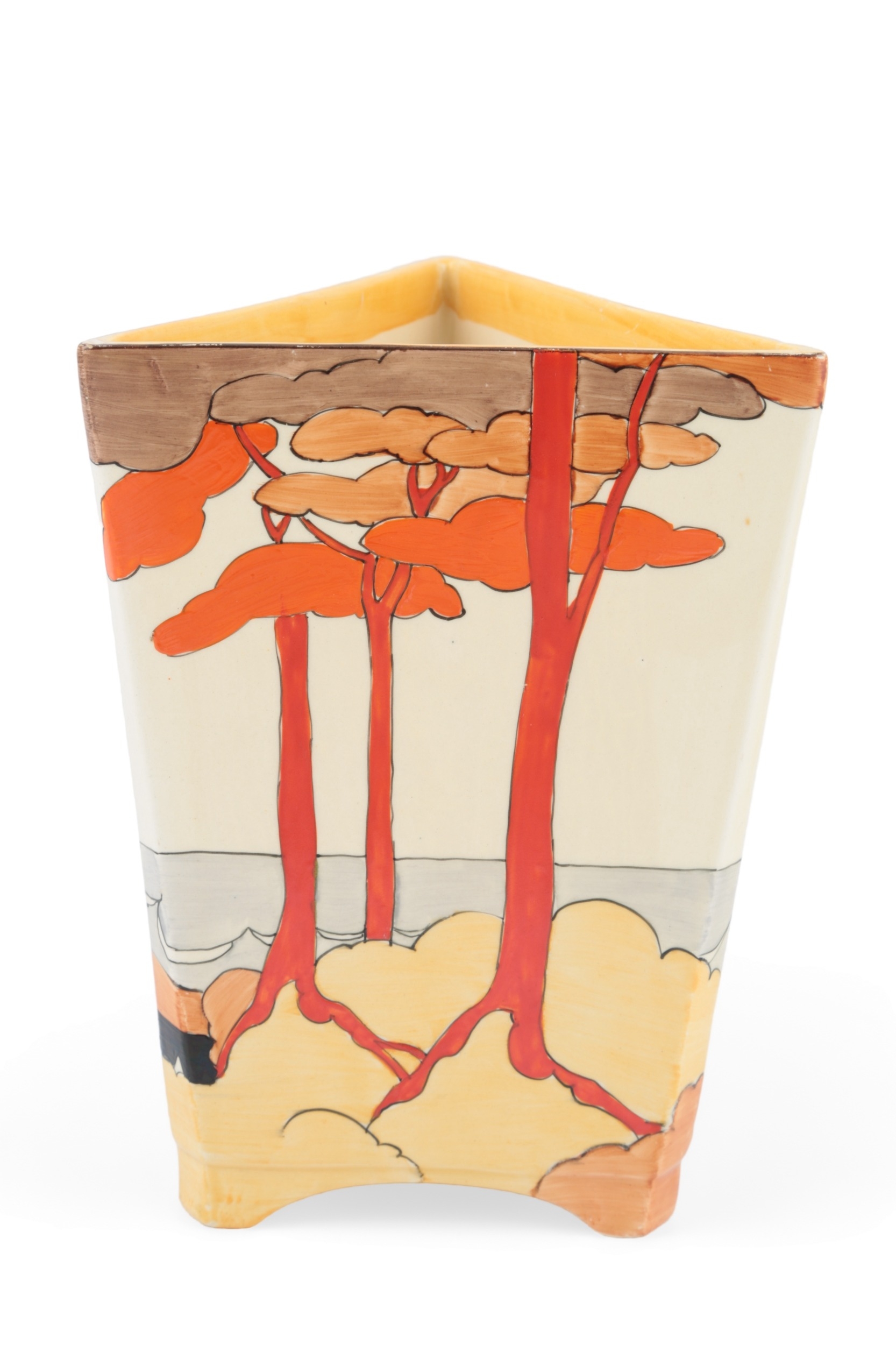
Gorringe’s gives this vase four useful views, which is exactly what a Clarice Cliff buyer wants. The triangular body, angular shoulder, painted “Coral Firs” pattern, and foot are all shown clearly enough to tell whether the first hit of colour is backed up by crisp edges, healthy surface, and a shape that still feels alive rather than simply well known.
Primary live lot today
Clarice Cliff: A Bizarre “Coral Firs” triangular vase, shape 200, 19cm high, Lot 259
Auction house: Gorringe’s
View live lot listing
Estimate: £500–£700
Why this lot is interesting
There is a reason Clarice Cliff remains one of the quickest names in British ceramics to wake a room up. The best pieces are not just colourful; they solve shape and decoration together. This vase earns attention because the triangular form gives the “Coral Firs” pattern somewhere dynamic to travel. On weaker Cliff pieces, the pattern carries the object. Here the form helps the picture do more.
The estimate also lands in a sensible place for a real design-name lot with recognisable Bizarre-period appeal. That makes it a useful buyer’s lot rather than a fantasy object. At this level, value still turns on how well the painting sits on the pot, whether the edges stay crisp, and whether the base markings and wear read as reassuring rather than evasive. In short: a famous name, but still one where close looking matters.
What to inspect in the photos
- Rim and corners: triangular vases concentrate risk at the points. Look hard for tiny nibbles, smoothing, or overpaint where a sharp corner may have had a hard life.
- Pattern strength: check whether the black fir forms and coral-toned ground still feel crisp and balanced rather than washed out, rubbed, or patchy.
- Glaze consistency: Clarice Cliff buyers should always inspect for dullness, scratches, or cloudy areas that flatten the visual energy the piece is meant to carry.
- Foot and underside: confirm the base wear looks natural and that the painted and factory marks sit convincingly with the age and type of object.
- Profile honesty: make sure the body still reads true from multiple angles. A slight lean can be photographic, but it can also hint at firing irregularity or later damage history.
Comparator lots
- Clarice Cliff “Persian Inspiration” twin-handled lotus jug, Lot 258 — Auction house: Gorringe’s. view lot — Est. £100–£200
- Clarice Cliff eleven-piece “Crocus” teaware group, Lot 263 — Auction house: Gorringe’s. view lot — Est. £200–£300
- Clarice Cliff “Ravel” conical bowl, Lot 260 — Auction house: Gorringe’s. view lot — Est. £100–£150
UK media & culture context
Clarice Cliff still sits in a very British sweet spot: part Potteries history, part Art Deco optimism, part television-friendly collecting theatre. Pieces like this keep showing up because they do two jobs at once. They signal design literacy, but they are also legible to people who are not specialists. You do not need a lecture to understand why the colour and geometry work.
- V&A: Art Deco — Clarice Cliff — useful museum context for why Cliff’s bright colour and modern shapes still read as fresh rather than merely nostalgic.
- BBC Stoke & Staffordshire: The bizarre wares of Clarice Cliff — a good reminder that this is Potteries history as much as auction fashion.
- Historic England: Clarice Cliff blue plaque profile — places the work in a broader British design story rather than a narrow collector niche.
Market pulse
The broader secondary market still rewards strong Clarice Cliff pieces, but not all shapes and patterns travel equally. Buyers are paying for visual punch, recognised patterns, and condition confidence rather than simply buying any object with the right name on the base.
- Barnebys realised prices for Clarice Cliff — useful for seeing how widely results can spread once rarity, pattern, and form change.
- Antiques Trade Gazette guide to buying Clarice Cliff — practical trade-facing context on which ranges, motifs, and export history keep demand resilient.
Bottom line
This is exactly the sort of Clarice Cliff lot that deserves a proper pause before bidding. The shape is more interesting than standard tableware, the pattern is recognisable without being dull, and the estimate is serious but not absurd. If the corners are clean, the paint still has snap, and the underside reads honestly, the lot makes sense. If the points are softened, the pattern looks tired, or the base raises questions, the same name quickly becomes much less persuasive. Buy the object, not the legend.
Editorial analysis for educational purposes only. Final bidding decisions, fees, tax, shipping, and contract terms are handled by the auction house.