
Daily Deep Dive · 2 Apr 2026 · Jewellery
Lot Spotlight: a 9ct gold black-opal sliding pendant on a smooth-link chain (Lot 404), and why the buying decision turns on whether the opal’s drama survives close inspection
Opal pendants can look richer in a catalogue than they do in the hand. Sheffield Auction Gallery’s Lot 404 works because the estimate still leaves room for judgement: you are buying colour play, the honesty of a triplet stone, and a wearable gold mount, not just a dark oval that photographs well for one bright second.
Primary live lot today
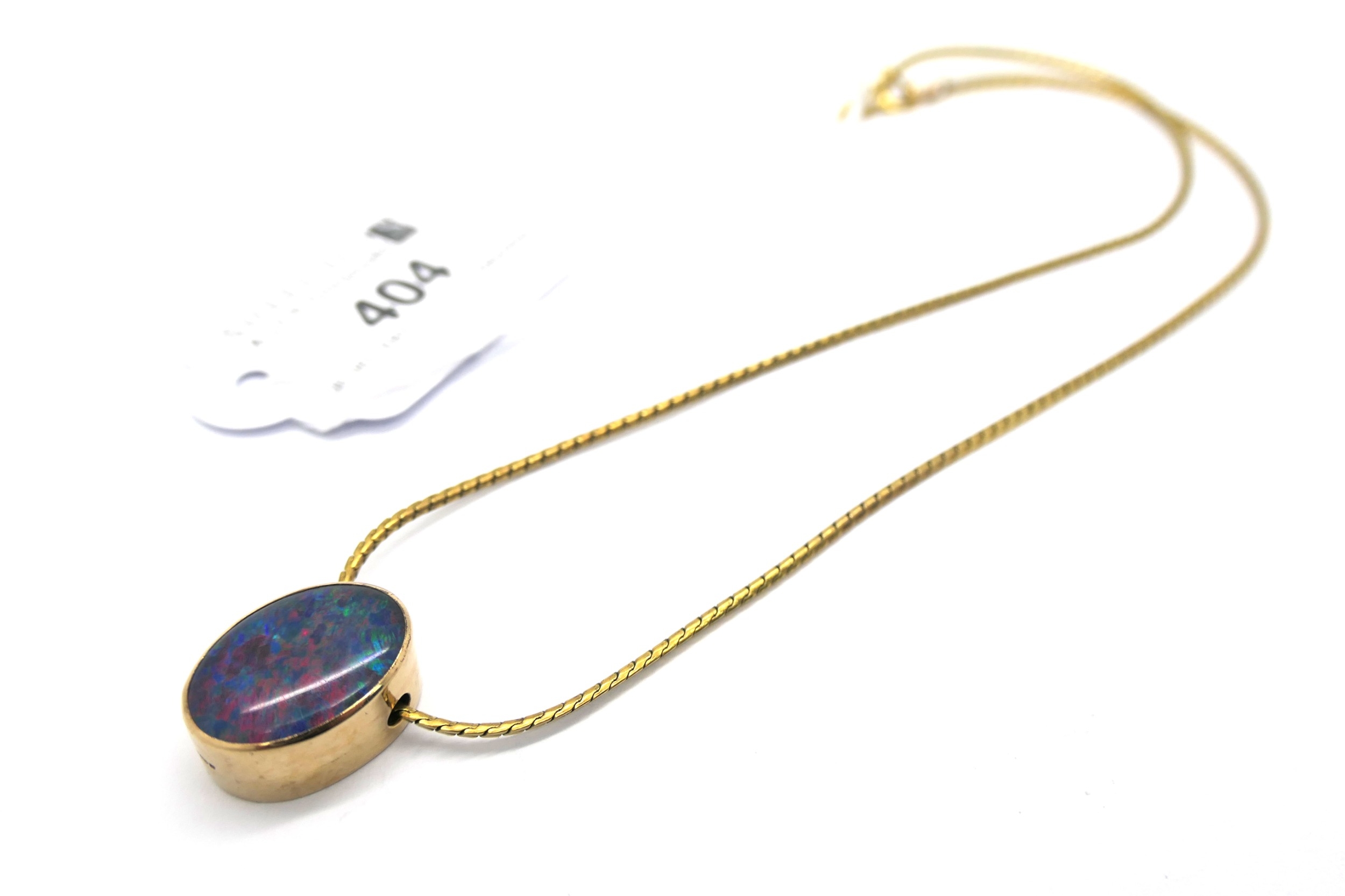
A 9ct Gold Oval Black Opal Sliding Pendant, (triplet) deep collet set, sliding on a 9ct gold smooth link chain (chain 40cm long), Lot 404
Auction house: Sheffield Auction Gallery
View live lot listing
Estimate: £250–£350
Auction date in listing: 23 Apr 2026
Why this lot is interesting
Black opal jewellery only earns its keep when the stone does more than sit there looking dark and expensive. This pendant is interesting because the listing gives enough photography to test the real appeal: flashes of blue and green against a dark ground, a mount that frames rather than smothers the stone, and a chain that looks like part of the original proposition rather than a convenient hanger added later. The estimate is high enough to demand scrutiny but not so high that every buyer has to pretend they are chasing a museum piece.
The word that matters here is triplet. Triplets can be perfectly sensible buys, but they are not judged like solid opals. The cap can scratch, the layered construction can flatten subtle colour, and the value sits in attractive wearability rather than geological heroics. That does not make the lot weak. It simply means the winner should be buying a good-looking, hallmarked gold pendant with convincing play-of-colour, not paying as if rarity is guaranteed by the catalogue photograph.
Who buys this and why
- Jewellery buyers who actually plan to wear it: the 40cm chain and sliding pendant format make this a straightforward neck-level piece rather than a safe-deposit-box purchase.
- Gift buyers trading up from new retail: a hallmarked 9ct gold mount with visible opal fire can feel more characterful than a polished high-street pendant at similar money.
- Trade and vintage-stock buyers: interested if the opal reads lively under more than one lighting angle and the mount is clean enough to retail without expensive remedial work.
Condition pressure points
- Triplet honesty: look for the tell-tale domed protective cap and make sure you are comfortable with layered-stone construction rather than assuming a solid black opal.
- Surface scratches and edge lifting: inspect the top surface and the perimeter where the cap and body meet; damage there can rob the stone of life quickly.
- Colour play versus one-angle theatre: the best opals stay interesting when the light shifts. If all the drama comes from one catalogue angle, bid accordingly.
- Collet and bale wear: check whether the deep collet setting is crisp and even, and whether the sliding mechanism has worn grooves or been repaired.
- Hallmarks and chain logic: the listing says pendant and chain are hallmarked 9ct. Make sure the marks are legible and the chain feels like a coherent partner rather than a later substitute.
- Diamond accents: these are garnish, not the thesis. Treat them as decorative support unless the photos prove more.
Comparator lots
These comparators stay in the opal-pendant lane but show three different buying temperatures: higher-carat dress jewellery, a ruby-accented mid-market pendant, and a silver black-opal piece where design does more of the work than metal value.
- 18ct Gold Necklace, 16 Inch Chain, Black Opal Triplet Pendant with Diamond Accents, Lot 17 — Auction house: Money Maker Auctions. Estimate: £500–£530. view lot
- 9ct Gold Opal & Ruby Pendant on 9ct Chain, Lot 519 — Auction house: Locke's Auctioneers. Estimate: See listing. view lot
- Black Opal Greek Key Designed 925 Silver Pendant Necklace, Lot 659 — Auction house: Phixius Auctions. Estimate: See listing. view lot
UK media & culture context
Britain has always had a soft spot for pendants that let the stone perform. In the better examples, the chain disappears and the gem does the talking; in the weaker ones, all the persuasion is left to the metalwork and the lighting setup. That is why opal pendants remain such a live buying lane here: they sit somewhere between sentimental jewellery, dress jewellery, and a small act of theatre.
- V&A: Guild of Handicraft opal pendant, c.1903 — a useful British reference point for how opal was used when the stone itself, rather than sheer size, carried the romance.
- V&A jewellery collection overview — broader context for why pendants remain one of the most legible forms in historic and contemporary jewellery buying.
- Sheffield Assay Office: UK hallmarks — particularly relevant here because a wearable gold pendant-and-chain lot lives or dies on what the marks prove, not what the catalogue implies.
Bottom line
This is a neat jewellery lot if you want a convincing-looking opal pendant to wear, and if you are disciplined enough to price it as a triplet from the outset. The estimate feels fair when the colour stays alive across multiple photos, the hallmarks are honest, and the chain belongs with the pendant. If you are really hunting a solid-opal trophy, this is the wrong lane; if you want elegant sparkle with properly managed expectations, it is one of the cleaner jewellery lots on the board.
Editorial analysis for educational purposes only. Final bidding decisions, fees, tax, shipping, collection, condition verification, and contract terms are handled by the auction house.