
Daily Deep Dive · 29 Apr 2026 · Furniture
Lot Spotlight: the useful G-Plan sideboard that earns its keep only if the photos prove it is still disciplined furniture rather than tired nostalgia
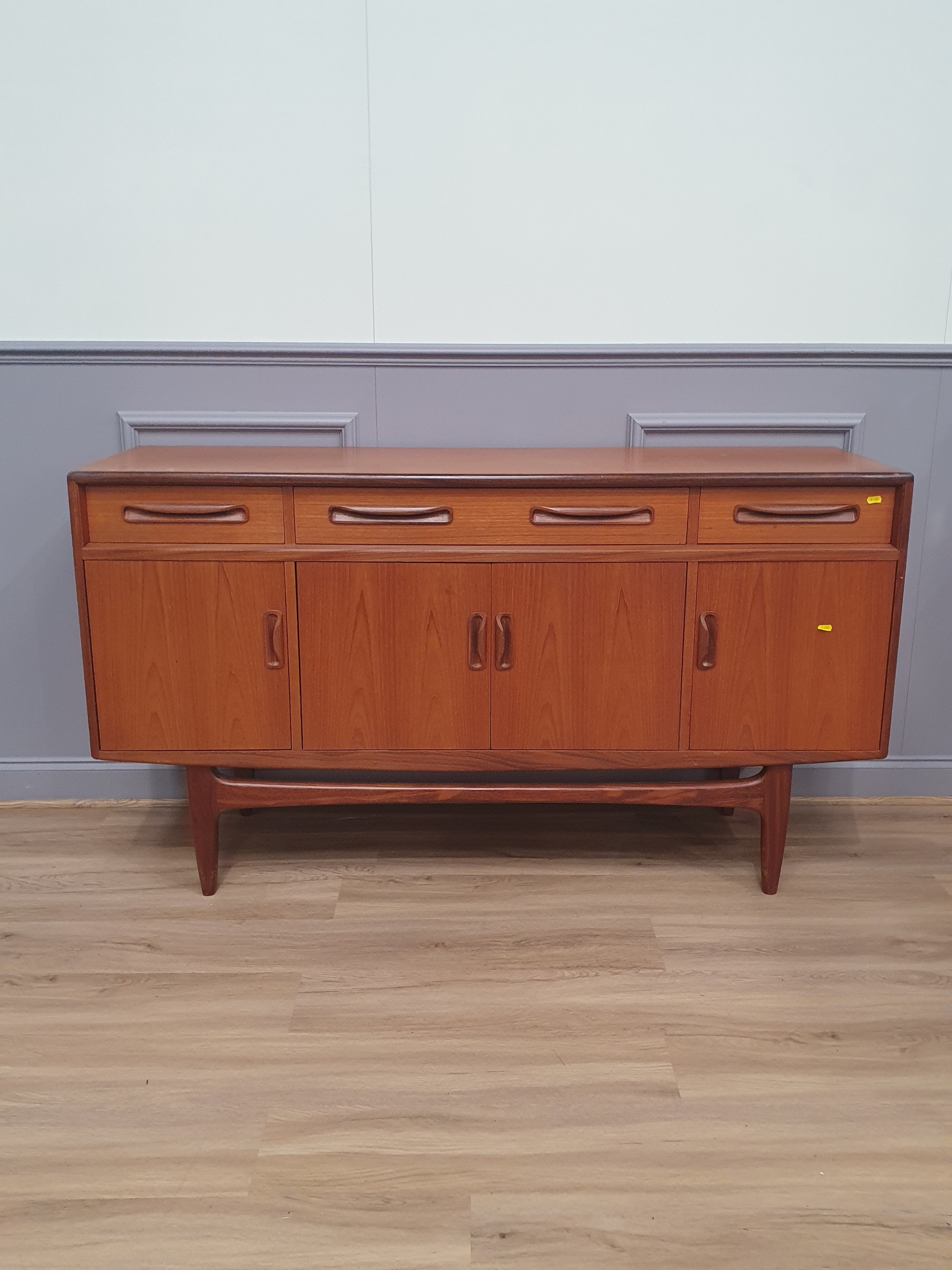
G-Plan pieces often sell on recognition before they sell on quality, which is exactly why Minster Auctions’ Lot 550 is worth a slower read. The catalogue gives a named maker, a straightforward form, and at least five useful images at a true 2500px height, which is enough to ask the right questions before the mid-century glow gets sentimental. This teak sideboard is not rare and it is not trying to be. The attraction is that it still looks like proper working British furniture: four drawers above four doors, shaped supports rather than a plinth, and proportions that should sit easily in a dining room, hallway, or office. The whole case rises or falls on whether the top, the door lines, and the surviving finish still look crisp enough to make the label mean something.
Primary live lot today
G-Plan teak sideboard fitted four drawers above four cupboard doors, one bearing maker's label, raised on shaped supports, 33in high x 5ft long x 18in deep, Lot 550
Auction house: Minster Auctions
View live lot listing
Estimate: £150–£250
Auction date in listing: 29 Apr 2026
Catalogue note: G-Plan teak sideboard with four drawers, four cupboard doors, maker's label, and shaped supports.
Why this lot is interesting
The estimate is the first reason to take this seriously. At £150–£250, Minster Auctions is not pitching this as a design-icon trophy. It is pricing it in the lane where sensible buyers can still get a recognisable British mid-century name without paying dealer-shop money, provided the cabinet has not been quietly defeated by rings, bleaching, wobbly hinges, or a top that only looks straight because the photographs are kind.
The second reason is that the form is commercially useful. Big sideboards survive because they do a job. G-Plan’s appeal is not only about taste or nostalgia; it is about giving ordinary storage a touch of authority. This one has enough width to anchor a room but not so much that it becomes a landlord special. If the teak still has warmth and the supports still read cleanly, it lands in the sweet spot between decorative credibility and everyday use.
Who buys this and why
- First-time mid-century buyers: they want a recognisable British name and a piece that can change a room without asking for heroic money or specialist scholarship.
- Interior buyers furnishing properly: they are less interested in design-history bragging rights than in whether the cabinet gives a wall real structure, warm timber, and concealed storage.
- Dealers and trade pickers: they will look hard at the top, the colour consistency, and the maker's label because the margin disappears fast once restoration, collection, and transport are added back in.
Condition pressure points
- Read the top surface like a dining table, not like a brand asset: sideboards this size often carry plant-pot shadows, drink rings, sun fade, and edge knocks. Ask for the longest, flattest top-view image you can get.
- Check door discipline: four cupboard doors should sit with even gaps. Any dropped hinges, warped fronts, or doors that meet awkwardly will make the whole cabinet feel cheaper in person than it does online.
- Inspect the maker's label properly: the label helps the buying case, but only if it is original, legible, and matched by the general quality of construction rather than doing all the work by itself.
- Study the supports and lower rails: shaped legs and bases catch vacuum knocks, shoe scuffs, and damp-floor wear. This is where otherwise tidy teak pieces often start telling the truth.
- Look inside the cupboards: shelves, interiors, and drawer runners matter because a sideboard with a handsome front and a tired interior quickly becomes an expensive stage prop.
Comparator lots
These comparators stay in the British mid-century storage lane and help triangulate whether you want this exact practical G-Plan balance, a broader decorative version of it, or an earlier E Gomme story.
- Mid 20th century teak G-Plan sideboard, Lot 1084 — Auction house: Potters Auction Saleroom Ltd. Estimate £80–£120. Slightly larger dimensions in the catalogue and a lower estimate, useful for checking whether Minster’s example looks tighter or simply pricier. view lot
- E Gomme for G-Plan early light oak sideboard, Lot 1073 — Auction house: Tayler and Fletcher. Estimate £80–£120. An earlier, more drawer-heavy take on the same buying lane, helpful if you prefer period character and construction detail over later teak smoothness. view lot
- G Plan mid-century teak sideboard, Lot 285 — Auction house: Richard Winterton Auctioneers. Estimate No estimate. The condition report flags marks, scuffs, stains, scratches, discolouration, and usage wear, which makes it a useful reality check on how quickly this category turns from stylish to merely serviceable. view lot
UK media & culture context
G-Plan still matters in Britain because it sits in the post-war moment when ordinary domestic furniture started being sold as modern living rather than inheritance. A sideboard like this is not just teak storage. It is a surviving piece of the British promise that good design could live in a normal semi and still feel aspirational.
- V&A furniture collections — useful museum context for how British buyers learned to treat domestic furniture as design history rather than mere utility.
- Design Museum exhibitions — a good reminder that post-war interiors and modern domestic design are still live cultural territory, not just dealer shorthand.
- The Twentieth Century Society — helpful wider context for why everyday post-war British design still has a live audience beyond pure nostalgia.
Bottom line
This is not the sort of G-Plan lot you chase because the name makes your pulse jump. It is better than that. If the top is honest, the doors sit square, the label is clean, and the teak still carries some depth, Minster Auctions’ estimate leaves room for a buyer who wants proper mid-century usefulness with enough design confidence to hold a room together. If the cabinet is dry, tired, or fighting its own alignment, the logo will not save it.
Editorial analysis for educational purposes only. Final bidding decisions, fees, tax, shipping, collection, condition verification, authenticity, restoration disclosure, and contract terms are handled by the auction house.