
Daily Deep Dive · 5 May 2026 · Furniture
Lot Spotlight: a modest G Plan sideboard that only earns real money if the cabinet still feels stricter than the nostalgia around it
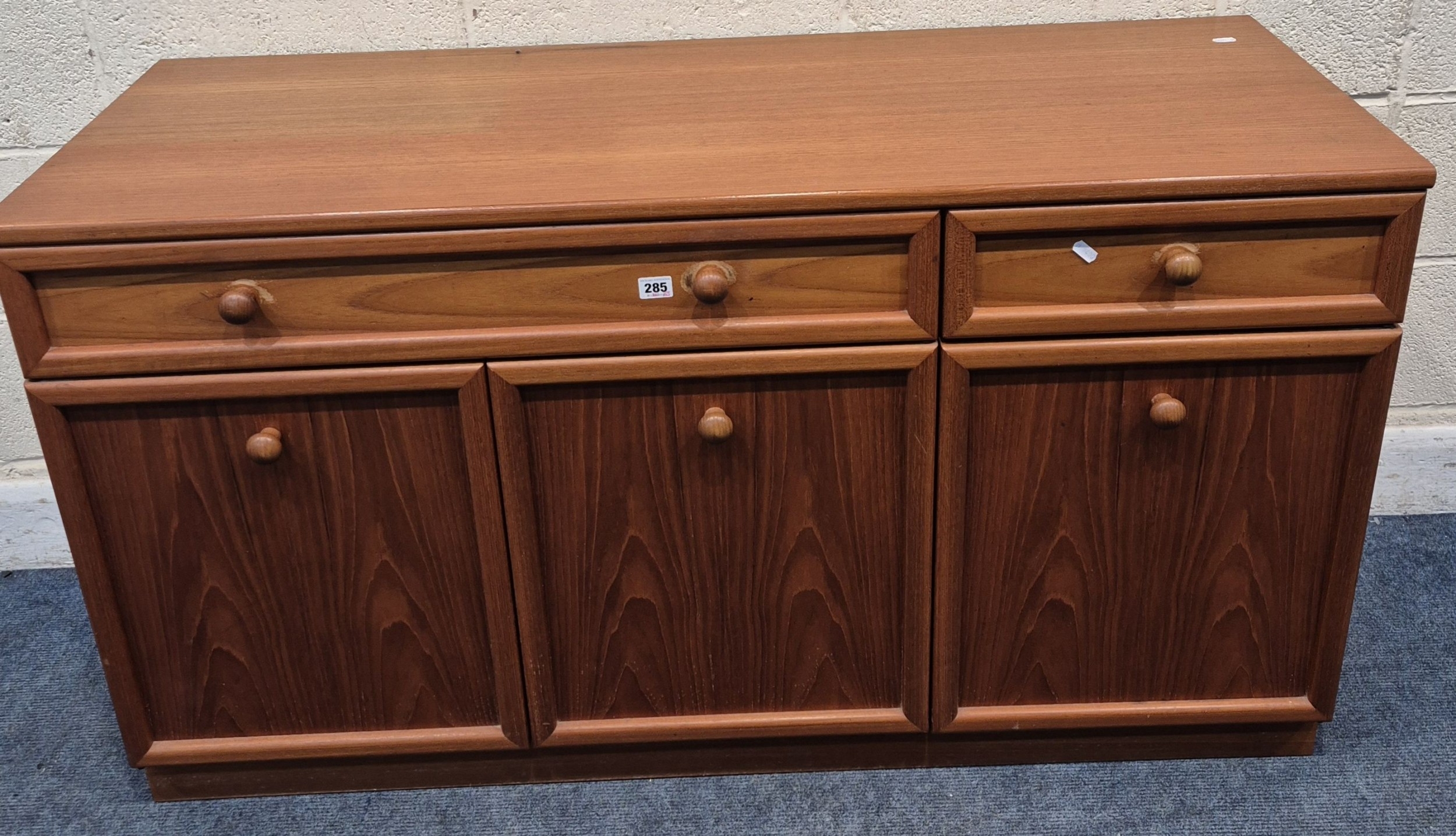
The middle of the G Plan market is where buyers get tested. Richard Winterton Auctioneers has a live mid-century teak sideboard, Lot 285, fitted with two drawers over three cupboard doors and measured at 130cm wide, and the catalogue gives six photographs plus a verified 2500px image family to judge whether the piece is still disciplined furniture or simply another warm-toned survivor trading on the badge. The attraction is obvious enough: compact scale, recognisable British name, and a form that can work in a dining room, hallway, or flat without swallowing the wall. The harder question is whether the marks, scuffs, stains, light scratches, discolouration, and general usage wear disclosed in the condition report still leave enough authority in the top, front line, and colour to make this a buy rather than a compromise.
Primary live lot today
G Plan, a mid-century teak sideboard fitted with two drawers over three cupboard doors, width 130cm x depth 49cm x height 73cm, Lot 285
Auction house: Richard Winterton Auctioneers
View live lot listing
Estimate: No estimate published
Auction date in listing: 5 May 2026
Catalogue note: Condition report states marks, scuffs, stains, light scratches, discolouration, other wear and usage
Why this lot is interesting
This one is interesting because it sits below the glamorous end of the G Plan story and therefore forces the right question first: are you buying design, or are you buying a familiar name wrapped around serviceable storage? The dimensions are practical, the layout is legible at a glance, and the cabinet does not need a huge room to make sense. That makes it the sort of lot younger collectors, careful decorators, and trade buyers can all plausibly use.
The listing is also honest in a way that helps. Richard Winterton Auctioneers is not pretending this is untouched teak perfection. The stated wear means the value lives in whether the front still reads straight, whether the drawer stack and cupboard rhythm still feel balanced, and whether the colour remains even enough that the sideboard looks composed in daylight rather than merely cosy in catalogue crop. In this bracket, candour is more useful than romance.
Who buys this and why
- First serious mid-century buyers: they want a recognisable British maker and a piece that can organise a room without demanding top-tier dealer money.
- Interior buyers furnishing for use: they are buying proportion, storage, and teak warmth, but they still need the cabinet to look orderly enough that it carries a wall rather than just filling one.
- Dealers and house-clearance pickers: they will see resale potential only if the top, colour, and door fit are clean enough that the condition note does not become the whole conversation.
Condition pressure points
- Read the top like a working surface: the catalogue has already warned you about marks, stains, and scratches. Ask for the longest possible view across the top because that is where watered rings, sun fade, and edge knocks start deciding the lot.
- Watch the door line, not just the teak glow: three cupboard doors need even gaps and a calm front elevation. Dropped hinges or a slightly twisted carcass can make a G Plan piece feel cheaper in person very quickly.
- Check colour consistency: discolouration matters more on teak than many buyers admit. Look for one panel going grey, orange, or washed-out against the rest of the front.
- Study the drawer rhythm: two drawers over three doors is a neat arrangement when the runners are true and the fronts sit flat. If one drawer pulls proud, the whole cabinet loses authority.
- Inspect the lower edge and feet area: the base is where vacuum knocks, damp-floor wear, and transport damage tend to gather. A tidy face with a tired underside is still a tired sideboard.
Comparator lots
These comparators stay in the same live G Plan storage lane and help frame the real choice: compact honesty, retro styling, or a lower wider format for the same general room function.
- G Plan sideboard, Lot 788 — Auction house: Nock Deighton. Estimate No estimate published. A second current G Plan sideboard route, useful as a check on whether Richard Winterton’s smaller cabinet feels tighter and more practical or simply less ambitious. view lot
- Retro G Plan sideboard, Lot 885 — Auction house: Hartleys Auctions Ltd. Estimate No estimate published. A useful comparator if your taste leans more overtly retro, and a reminder that the name alone does not tell you whether the cabinet is crisp, tired, or over-familiar. view lot
- G Plan low sideboard, Lot 902 — Auction house: Hartleys Auctions Ltd. Estimate No estimate published. Helpful if you prefer a lower, broader silhouette and want to test whether today’s Richard Winterton example wins on compact usefulness or loses on presence. view lot
UK media & culture context
G Plan still lands in Britain because it belongs to that post-war promise that ordinary domestic furniture could be modern, aspirational, and genuinely useful at the same time. The best examples do not feel like museum furniture. They feel like design that expected to be lived with, which is exactly why condition discipline matters so much now.
- V&A furniture collections — broad museum context for why domestic furniture is still read as design history rather than just household stock.
- Design Museum exhibitions — a useful current reminder that post-war interiors remain active cultural territory in Britain, not merely dealer shorthand.
- The Twentieth Century Society — helpful context for the continuing UK audience for everyday modern design, from architecture down to the furniture that sat inside it.
Bottom line
This is not a sideboard for buyers who want G Plan to do all the work for them. It is a sideboard for buyers prepared to read wear properly. If the top is calmer than the condition note makes you fear, the doors sit straight, and the colour still feels even enough to carry a room, Richard Winterton Auctioneers’ lot could be a sensible buy. If the cabinet looks thirsty, patchy, or structurally tired, the teak warmth will turn into homework very quickly.
Editorial analysis for educational purposes only. Final bidding decisions, fees, tax, shipping, collection, condition verification, authenticity, restoration disclosure, and contract terms are handled by the auction house.