
Daily Deep Dive · 15 May 2026 · Ceramics
Lot Spotlight: a large Moorcroft Pomegranate vase where the rim, tubelining, and pewter collar decide whether the richness still feels authored
Some Moorcroft pieces trade on colour alone. This one should not need to. Potteries Auctions Ltd has a live large Pomegranate-pattern cylindrical vase, Lot 136, standing 29cm high on a pewter-mounted base and backed by two crisp catalogue images from a verified 2000px image family. That is enough to ask the useful question before the berries and deep red ground do their work on you: does the pot still have the discipline to carry one of Moorcroft’s most recognisable patterns up to that flared rim, or is the visual drama doing a bit too much of the lifting?
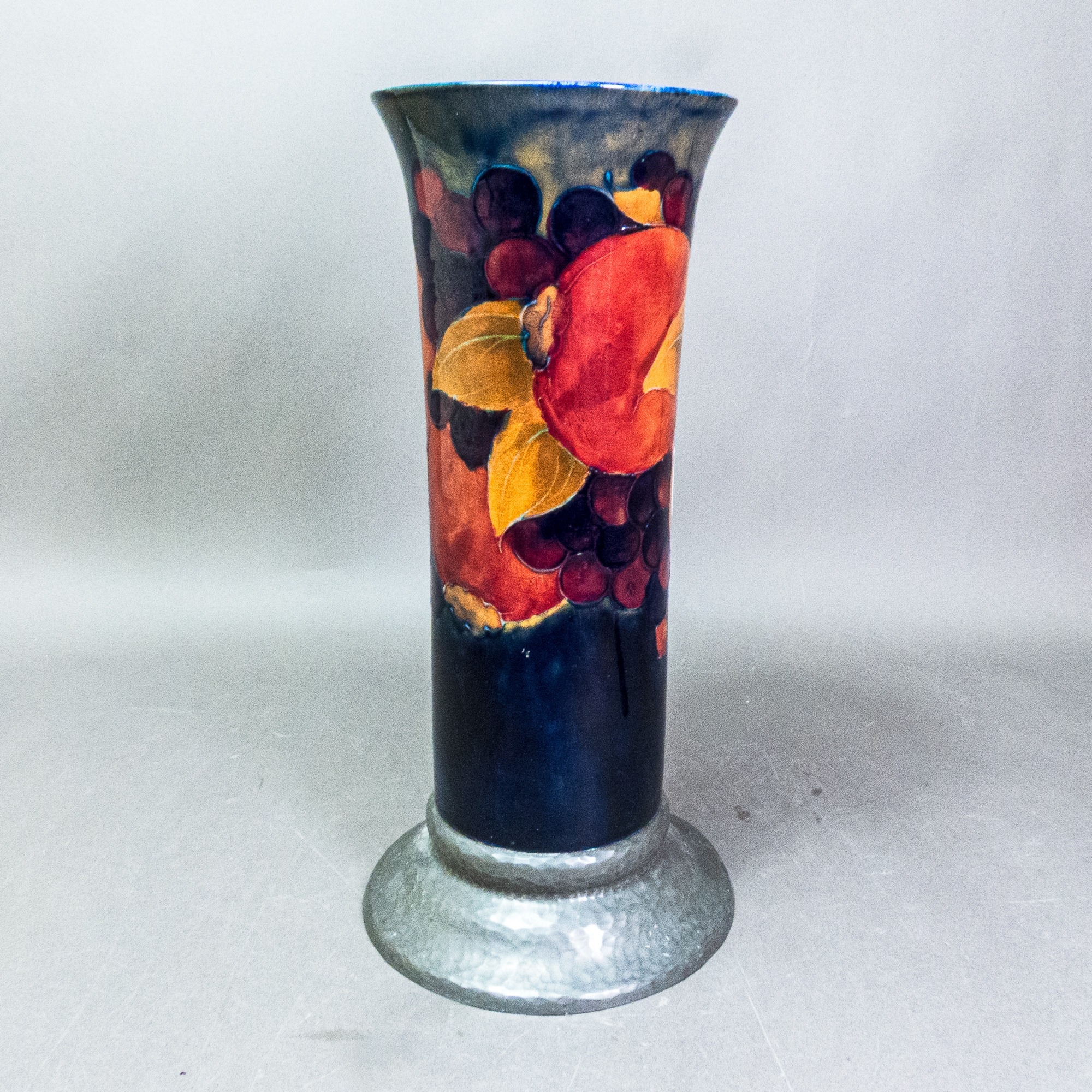
Primary live lot today
Large Moorcroft Pomegranate pattern cylindrical vase with flared rim on a pewter base, Lot 136
Auction house: Potteries Auctions Ltd
View live lot listing
Estimate: £150 - £300
Auction date in listing: 15th May 2026 at 10am BST
Photo coverage: 2 catalogue images, with a verified 2000px full-size source
Why this lot is interesting
Pomegranate is one of those Moorcroft designs that can flatter a weak shape for longer than buyers care to admit. On a large cylinder like this, it has nowhere to hide. The repeated fruit and berry clusters need enough tube-lined crispness to stop the surface becoming muddy, and the tall body needs enough authority to stop the pattern feeling simply wrapped around a big pot. When that balance holds, you get exactly what collectors want from classic Moorcroft: colour, relief line, and a shape strong enough to carry a room rather than just decorate a shelf.
The pewter-mounted base is the extra wrinkle. It may be original to the presentation of the vase, or it may simply be part of how this example has lived, but either way it becomes part of the buying judgement. A metal collar can sharpen the profile and make a substantial vase feel more architectural. It can also distract from chips, restoration, or a foot that needs a closer read. That is why this lot is better than a generic "pretty Moorcroft" listing. It asks you to judge how the ceramic body, the mount, and the surviving surface all behave together.
Who buys this and why
- Moorcroft collectors: they are buying one of the maker’s signature visual languages in a scale large enough to matter, with a pattern that still reads immediately to British art-pottery buyers.
- Interiors buyers: they want a single ceramic object with enough size and saturation to anchor a mantel, console, or corner cabinet without having to assemble a group.
- Dealers and trade buyers: they are looking for a classic Stoke-on-Trent name in a dependable decorative pattern, provided the rim, base, and glaze condition stay honest enough to support resale.
Condition pressure points
- Read the tubelining around the fruit clusters: on Pomegranate, soft or flattened linework can make a large vase look expensive in a thumbnail and tired in person.
- Slow down at the flared rim: this is exactly where knocks, glaze bruises, and over-restoration can hide on a shape that otherwise presents well from the body downward.
- Inspect the pewter mount as part of the object, not as decoration around it: check that the collar sits cleanly and does not raise awkward questions about concealment, later adaptation, or stress at the foot.
- Use the base view for marks and honesty: Moorcroft notes that signatures and marks help identify designer, period, and production details, so blurred or partly hidden marks are not a trivial issue.
- Ask directly about crazing and restoration: rich colour can disguise a surprising amount in catalogue photography, especially on darker grounds.
- Remember the real spend: the estimate looks approachable for a large named Moorcroft vase, but Potteries Auctions Ltd’s buyer fees quickly turn a casual bid into a more serious decision.
Comparator lots
These stay in the Moorcroft vase lane and help frame today’s lot by shape, condition tension, and buying bracket rather than by drifting into generic British ceramics.
- Large Moorcroft Orchid-pattern vase, Lot 137 — Auction house: Potteries Auctions Ltd. Same sale, similar scale, but the catalogue explicitly notes a hole to the centre of the base. That makes it a useful reality check: if today’s Pomegranate vase is structurally calmer, it deserves a premium over a taller but compromised neighbour. view lot
- Moorcroft ‘Leaf and Berries’ pattern vase, Lot 305 — Auction house: Leighton Hall Auctions. A smaller live example with three catalogue images and a lower estimate, useful for seeing how much of today’s value sits in sheer scale and presence rather than in the Moorcroft name alone. view lot
- William Moorcroft Pomegranate-on-ochre small vase with Royal Worcester companion, Lot 905 — Auction house: Fieldings Auctioneers Ltd. This is the sharper pattern-specific comparator because it brings Pomegranate back into view but with disclosed rim damage and a mixed-lot format. It helps show how quickly condition and lot structure can change the buying lane, even when the pattern is doing the talking. view lot
UK media & culture context
Moorcroft still lands culturally because it is not just another pottery name from Stoke-on-Trent. The Moorcroft Heritage Visitor Centre describes the 1913 factory and its Grade II listed bottle oven as part of the city’s ceramic identity, while the Potteries Heritage Society notes the Cobridge site’s continuing place in that industrial story. Cannon Hall Museum makes the collecting case from another angle: its ceramics collection treats Moorcroft as a significant strand of British art pottery spanning the full production period from 1897 onward, rooted in the Arts and Crafts emphasis on hand making. Moorcroft’s own guidance on signatures and base marks is useful here too. A big decorative vase like this should still be read from the underside as well as the front, because the marks help place the object, not just decorate it. That is exactly why today’s lot is interesting: the appeal is immediate, but the authority still has to be earned in the details.
- Moorcroft Heritage Visitor Centre — useful on the 1913 factory, the listed bottle oven, and why Moorcroft still sits centrally in Stoke-on-Trent’s pottery identity.
- Potteries Heritage Society: Moorcroft — concise confirmation of the Cobridge site and its place in the Potteries landscape.
- Cannon Hall Museum ceramics collection — helpful museum context for Moorcroft as an important British art-pottery collecting lane linked to Arts and Crafts making.
- Moorcroft FAQs on signatures and marks — a practical reminder that base marks help with dating, design attribution, and reading the piece properly.
Bottom line
If the rim is clean, the tube-lining stays lively, and the pewter-mounted foot looks integrated rather than evasive, this is a persuasive large-format Moorcroft buy with enough authority to justify the estimate. If the mount starts to look like camouflage, let somebody else pay for the colour.
Editorial analysis for educational purposes only. Final bidding decisions, fees, tax, shipping, collection, condition confirmation, and contract terms are handled by the auction house.