
Daily Deep Dive · 19 May 2026 · Ceramics
Lot Spotlight: a late-Victorian Minton spill vase pair that only works if the celadon glaze stays crisp and the sentiment never turns sugary
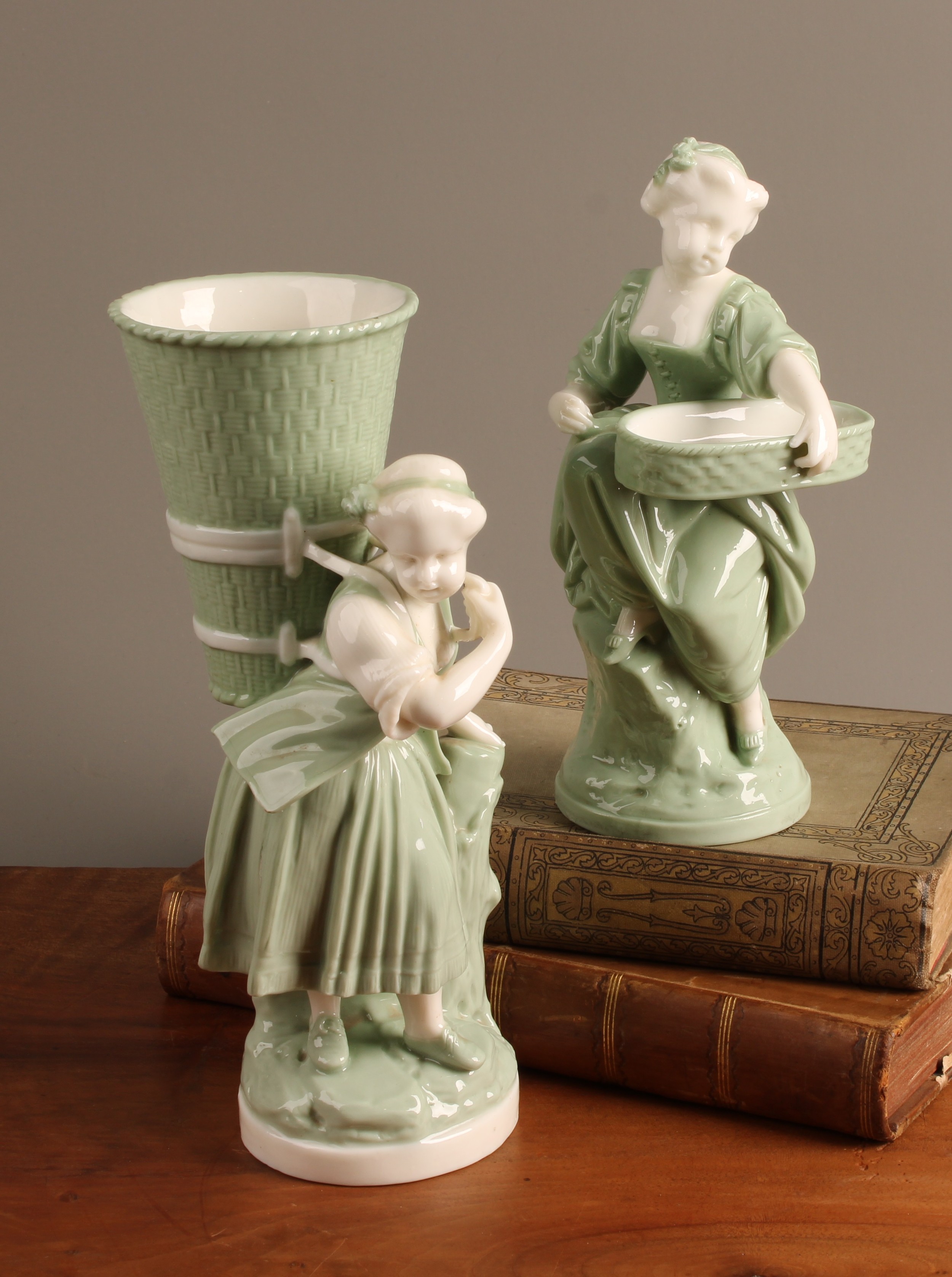
Dealers buy this sort of Minton on modelling and surface; private buyers are more likely to fall for the story first. Bamfords Auctioneers & Valuers has a live late 19th-century figural spill vase with a companion basket girl, Lot 814, carrying six catalogue photographs and a verified 2500×3353 full-size image. That is enough to treat it as a proper ceramics decision. The appeal is easy to understand: soft celadon glaze, domestic Victorian charm, and the kind of figural pair that can wake up a mantel without needing cabinet-level money. The harder question is whether the hands, basket edges, spill mouth, and facial modelling still look sharp enough that you are buying authored late-Victorian porcelain rather than paying for prettiness with repairs hiding in the folds.
Primary live lot today
Minton figural spill vase and companion figure, Lot 814
Auction house: Bamfords Auctioneers & Valuers
View live lot listing
Estimate: £80–£120
Auction date in listing: 19 May 2026 at 10am BST
Photo coverage: 6 catalogue images, with a verified 2500×3353 full-size source
Why this lot is interesting
Victorian figural ceramics can turn maudlin very quickly. This pair is better than that because Minton knew how to keep decorative sentiment anchored by proper modelling. The spill vase figure has enough lift in the shoulders and basket arrangement to feel composed rather than merely cute, while the companion figure gives the lot a useful comparison point inside the same glaze family. You are not just buying one decorative pose. You are buying a small lesson in how late-19th-century English porcelain balanced parlour charm with factory discipline.
The celadon glaze is doing real work here. It cools the subject down and stops the pair becoming over-painted Victorian theatre. That matters because the form itself is vulnerable to fussiness: fingers, drapery edges, spill rim, basket weave, and the transition between base and figure all need to stay legible. If they do, this is a convincing lower-middle estimate buy for someone who wants period English porcelain with personality. If they do not, the lot risks sliding into the awkward zone where damage, softness, or restoration flatten the exact grace you are paying to keep.
Who buys this and why
- Minton and Victorian ceramics collectors: they want an affordable entry into the factory’s later decorative lane, where modelling, glaze choice, and surviving sharpness matter more than size.
- Interior buyers furnishing mantelpieces or bookcases: they are buying atmosphere, but a calmer, cooler atmosphere than the louder pink-and-gilt Staffordshire route.
- Dealers and decorative-arts resellers: they are looking for a named English porcelain lot with enough photographic evidence to judge whether the pair still has clean resale presence after premium and transport.
Where the risk sits
- Read the spill mouth first: the rim is the obvious fracture point, and even tidy restoration can make a spill vase lose authority very quickly.
- Slow down at the basket, fingers, and drapery tips: these projecting details chip, re-stick, and soften more often than buyers want to believe.
- Use the glaze as your honesty test: celadon should look settled and even, not patchy, over-cleaned, or suspiciously dead around repaired areas.
- Compare the two figures against each other: one strong figure can drag a weaker companion along in a pair lot, so check whether both pieces carry similar quality of modelling and surface condition.
- Inspect the impressed marks and the bases: wear should look believable, not aggressively scrubbed, and the marks should still help the factory attribution feel secure.
- Watch the faces: once Victorian figural porcelain loses crisp noses, mouths, and eyelids, it starts to look generic in the room even if the glaze still photographs well.
Comparator lots
These comparators stay in the spill-vase and small decorative-porcelain lane. The point is to test whether today’s bid belongs on named Minton figural charm, on a cleaner single-piece porcelain form, or on a much cheaper Staffordshire mantelpiece route.
- An English porcelain flared cylindrical spill vase with pink cabbage roses and eagle-mask handles, Lot 841 — Auction house: Bamfords Auctioneers & Valuers. Estimated at £60–£100, this is the more formal comparator: less narrative, more shape-and-decoration discipline, useful if you prefer a single stronger object over a sentimental pair. view lot
- A pair of Victorian Staffordshire pottery sheep spill vases, Lot 1377 — Auction house: Stride & Son Auctions Ltd. Estimated at £25–£30, these sit in the cheaper Staffordshire mantelpiece lane and help clarify whether you want named Minton refinement or simply the broad Victorian spill-vase look at a friendlier level. view lot
- A floral painted spill vase in a mixed porcelain lot, Lot 454 — Auction house: Minster Auctions. Estimated at £20–£30, this is the low-stakes decorative comparator for buyers who only want the spill-vase silhouette and are less concerned about factory name or figural modelling. view lot
UK media & culture context
Minton still matters in Britain because it sits right on the border between industrial pottery success and aspirational domestic taste. The Potteries history of Thomas Minton is useful here: the firm grew from practical Staffordshire production into one of the Victorian names that made ornament feel respectable in middle-class homes, not merely indulgent. The V&A’s writing on the artistic home sharpens the cultural lane. By the 1870s and 1880s, British art pottery and decorative ceramics were part of how households signalled taste, and Minton’s London art-pottery expansion helped make ceramic display a serious element of interior culture rather than just tableware overflow. The museum’s ceramics-history material adds the broader point: Minton was not a fringe maker but one of the firms woven into Britain’s national story of design education, public display, and decorative manufacture. That is why a modest spill-vase pair like this still has a buying lane now. It is not just Victoriana. It is a small surviving fragment of how British homes once staged gentility through porcelain on the mantel.
- The Potteries: Thomas Minton — concise history of Minton’s rise in Stoke-on-Trent and why the factory mattered in Victorian ceramics.
- V&A: Furnishing the aesthetic home — useful on British art pottery, decorative display culture, and why ceramics became part of tasteful domestic interiors.
- V&A: History of the Ceramics Galleries & Ceramic Staircase — broader museum context on Minton’s place in Britain’s public design history.
- V&A: The Artistic Home — helpful on late-19th-century British art pottery as part of the fashionable interior.
Bottom line
This is a good late-Victorian porcelain buy only if the grace survives the close look. If the glaze is even, the spill rim is clean, and both figures still keep their faces and basket detail, Bamfords’ estimate looks fair. If the softness is coming from old damage or repair rather than from Minton’s modelling, the charm will not compensate for it for very long.
Editorial analysis for educational purposes only. Final bidding decisions, fees, tax, shipping, collection, condition confirmation, and contract terms are handled by the auction house.