Daily Deep Dive · 20 May 2026 · Lighting
Lot Spotlight: a carved giltwood standard lamp that should be bought for its stance, not forgiven for a lazy electrical conversion
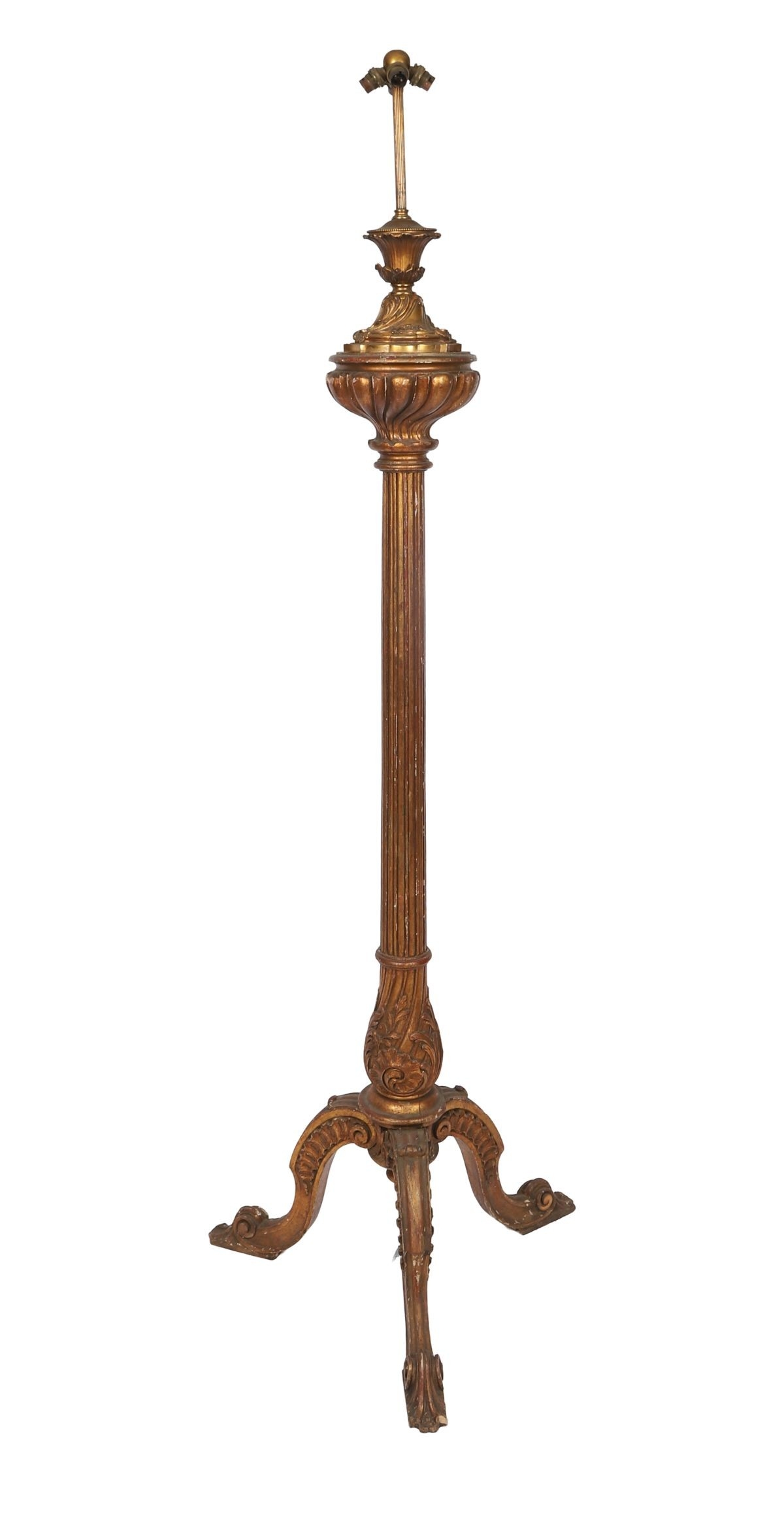
Country-house lighting can make buyers generous in exactly the wrong places. Sheppards Irish Auction House has a live late 19th-century carved giltwood standard lamp, Lot 1213, standing 200cm high and backed by three catalogue photographs plus a verified 1200×2322 full-size source. That is enough to treat it as a real decorative-lighting decision rather than a mood purchase. The attraction is obvious: fluted column, acanthus-carved capital, scrolling triform base, and the sort of faded-gold presence that can organise a room in a second. The harder question is whether the carving still has enough authority, the column still stands true enough, and the electrical adaptation looks disciplined enough that you are buying a convincing late-19th-century object rather than paying restoration money for a handsome silhouette.
Primary live lot today
Large late 19th-century carved giltwood standard lamp, Lot 1213
Auction house: Sheppards Irish Auction House
View live lot listing
Estimate: €300–€500
Auction end displayed in listing: 20 May 2026 at 18:10:48 BST
Photo coverage: 3 catalogue images, with a verified 1200×2322 full-size source
Why this lot is interesting
Single standard lamps are often better buys than pairs because they do not need to justify symmetry, only conviction. This one has a sensible decorative hierarchy: a fluted shaft that keeps the eye moving upward, a capital with enough carved lift to stop the top from dying under a shade, and a triform base with scrolling feet that gives the whole piece real room presence. At 200cm high, it is not pretending to be a side-table lamp scaled up. It wants to act like architecture.
The estimate is where it gets properly interesting. At this level, you are not being asked to pay elite English-lamp money for bronze mounts or documented maker glamour. You are being asked whether the object still reads as good decorative timber carving with convincing gilded surface and an electrical conversion you can live with. That is a better buying lane. If the carving is still sharp at the feet and capital, and the adaptation for electricity has been handled without brutal drilling or clumsy replacement parts, this is the sort of lamp that can make a hall, drawing room, or long corner feel more composed very quickly.
Who buys this and why
- Interior buyers furnishing period rooms: they want one tall piece that can supply atmosphere and vertical emphasis without committing to a full chandelier or pair of matching floor lamps.
- Dealers and decorators: they are buying scale, decorative carving, and a price point that still leaves room for rewiring, shade replacement, and transport.
- Restoration-minded private buyers: they see the appeal in a late-19th-century object that already accepts modern electrification, provided the conversion has not stripped away too much of the original character.
What the catalogue is not telling you
- Start at the top fitting, not the base: a standard lamp can look romantic from six feet away and still have a crude lampholder, odd reducer, or messy cable exit where the practical work was done.
- Check whether the column is genuinely straight: tall giltwood lamps can lean subtly after decades of movement, and a slight twist in the shaft is much more obvious in a room than it is in a catalogue crop.
- Read the carving at the feet and capital for losses: acanthus tips, lobes, and scrolling feet are exactly where chips, regilded repairs, and softened details hide.
- Use the gilding as your honesty test: consistent wear is fine; patchy bright gold, bronzed-over repairs, or dead flat repainting are less charming in person than sellers hope.
- Ask how the cable is run and whether the rewiring is recent: adapted-for-electricity is not the same thing as safely rewired, and old decorative lamps often need another round of work before they are ready for regular use.
- Do not ignore the shade question: a tall lamp like this rises or falls on proportion. If the existing shade is a placeholder, price in the cost of finding one with enough diameter and depth to balance the shaft.
Comparator lots
These comparators stay inside the same live lighting sale at Sheppards. They are not all the same form, but they help place today’s decision on the spectrum between usable period floor lighting, more architectural overhead lighting, and full country-house spectacle.
- Pair of Edwardian brass standard lamps, Lot 1039 — Auction house: Sheppards Irish Auction House. Estimated at €2,000–€3,000, these give you the matching-pair route and a more formal Edwardian brass look. They are the right comparator if you need symmetry and cleaner metal authority rather than carved-gilt character. view lot
- Large late 19th-century ormolu hall lantern, Lot 1264 — Auction house: Sheppards Irish Auction House. Estimated at €1,500–€2,500, this is the architectural overhead alternative: bevelled glass, pierced framework, and a stronger entrance-hall statement if you want ceiling drama rather than a floor-standing accent. view lot
- Extra-large French gilt metal and cut-glass chandelier, Lot 1237 — Auction house: Sheppards Irish Auction House. Estimated at €5,000–€8,000, this is the full leap into grand decorative lighting. It helps clarify whether today’s lot appeals because you want period lighting with manageable risk, or because you really want a much bigger room-scale showpiece. view lot
UK media & culture context
Britain’s decorative-lighting story gets interesting the moment old display objects had to coexist with new electricity. The National Trust’s history of Cragside is the cleanest reminder: by 1880, Joseph Swan’s incandescent bulbs were being installed in a British country-house interior, and decorative objects were being adapted into lamps rather than left in a pre-electric world. That matters here because today’s lot is exactly that kind of survivor from the long shift between ornamental furnishing and practical electrical use. The V&A’s conservation writing on Edward James’s surreal standard lamps is also useful. Even on a much grander 20th-century example, the museum’s emphasis falls on coatings, corrosion, past damp, and how surfaces age under later use and storage. In other words, decorative lamps are never just silhouettes. House & Garden’s recent vintage-lighting advice brings it into the present-day British interior market: antique lighting still earns its keep because patina and period fit can sharpen a room quickly, but only when buyers take rewiring and restoration seriously. That is the exact lane for this Sheppards lot. It is not just a tall lamp. It is a test of whether old decorative finish and modern usability still meet on respectful terms.
- National Trust: Cragside’s history — useful on early electric light in a British country house and why decorative fittings had to adapt to new technology.
- V&A Blog: Champagne standard lamps — museum conservation context on why surface coating, corrosion, and previous storage conditions matter with decorative standard lamps.
- House & Garden: How vintage lighting can transform an interior — current UK interiors context on why period lighting still appeals and why rewiring and proportion remain practical buying questions.
- House & Garden: The dos and don’ts of lighting your house — helpful on why floor lamps and mid-level lighting often feel more flattering and flexible than overhead glare.
Bottom line
This is a sensible decorative-lighting buy if the lamp still has backbone. If the column stands straight, the carved feet and capital remain crisp, and the electrification looks competent rather than improvised, the estimate feels entirely livable. If the gilding has gone patchy and the wiring story looks like a compromise, let someone else pay for the height.
Editorial analysis for educational purposes only. Final bidding decisions, fees, tax, shipping, collection, condition confirmation, and contract terms are handled by the auction house.