
Daily Deep Dive · 26 May 2026 · Ceramics
Lot Spotlight: a Minton Haddon Hall tea service that only earns its place if the set is genuinely complete and the prettiness has not done all the work
English floral tableware can look reassuringly settled before you have checked a single rim. Bamfords Auctioneers & Valuers has a live Minton Haddon Hall pattern tea service for eight, Lot 193, estimated at £50–£80, described as eight cups and saucers, side plates, five lunch plates, plus salt and pepper shakers. The pattern does exactly what it has always been designed to do: give ordinary tea things a little stately-house theatre. The buying call is less romantic. The listing offers one verified 2500×776 full-size catalogue image, which is enough to judge whether the service still reads as a coherent, displayable set and whether the border decoration stays fresh enough to feel wanted rather than inherited, but not enough to let anyone relax about hidden chips, rubbing, or mismatched replacements. That tension is exactly why this lot is worth a closer look.
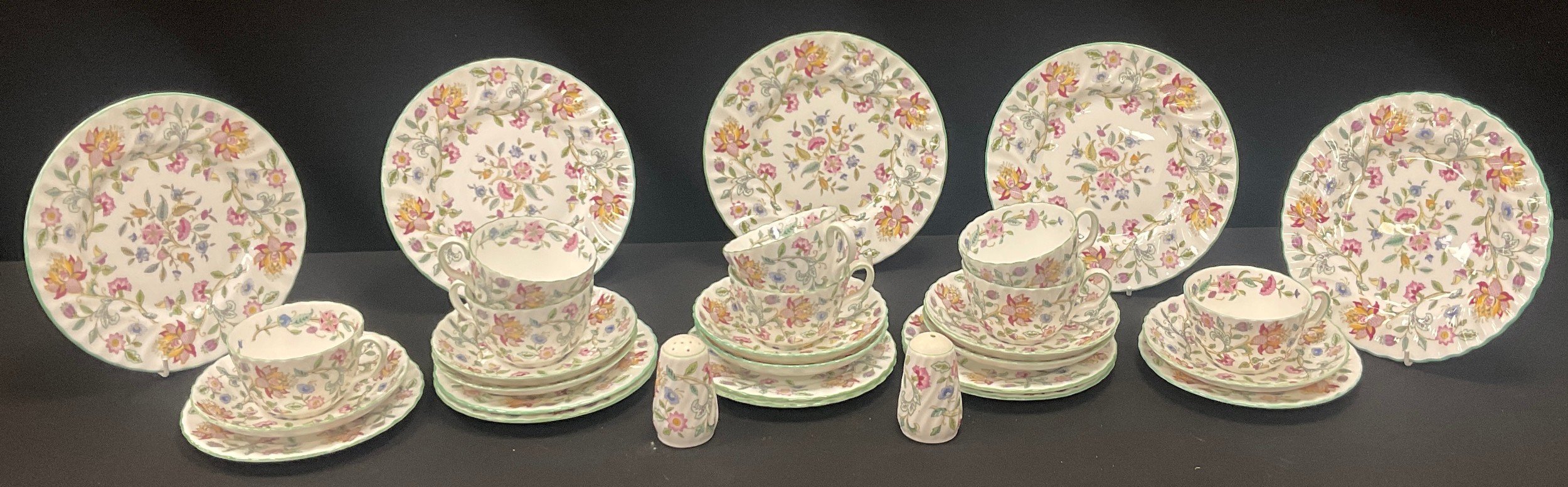
Primary live lot today
Minton Haddon Hall pattern tea service for eight, Lot 193
Auction house: Bamfords Auctioneers & Valuers
View live lot listing
Estimate: £50–£80
Auction date in listing: 27 May 2026 at 10:30am BST
Photo evidence: one verified 2500×776 full-size catalogue image
Why this lot is interesting
Haddon Hall is one of those British patterns that sells a mood before it sells a service. Buyers know what they are looking at in a second: cream ground, floral border, country-house name, and a reassuringly traditional table presence that can live happily in a kitchen dresser, a dining room, or a wedding-gift cupboard that still gets used. At this estimate, the attraction is not rarity. It is that the lot appears broad enough to function. A service for eight is immediately more persuasive than an orphaned teapot and four tired cups.
The weakness is equally obvious. Tea services stop being charming the moment replacements, chips, and wear start making the set feel assembled rather than kept. With Haddon Hall, the visual appeal is strong enough that buyers can excuse away exactly the things that matter most: odd counts, rubbed edges, hairlines, and one or two pieces that are only there to make the group photograph look fuller. This is a completeness buy first and a pattern buy second.
Who buys this and why
- Country-house traditionalists: they want recognisable English floral china that softens a room without needing specialist knowledge or cabinet-level money.
- Hosts who actually use tableware: they are buying a serviceable run of cups, saucers, and plates for teas, brunches, or a dresser that does not want to look too polished.
- Dealers and prop-minded interiors buyers: they see resale or staging potential if the counts stay honest and the decoration remains bright enough that the set still photographs well.
What the single wide photo is not telling you
- Count every visible piece against the description: a service only feels cheap until you discover the best plate is not part of the same run.
- Zoom hard on cup rims and saucer wells: the first chips usually hide where floral borders and pale ground encourage the eye to drift.
- Watch for gilding and border rub: Haddon Hall depends on decorative freshness more than heroic form, so wear reads quickly.
- Check whether the plates match in scale and depth of colour: slight differences can mean later substitutions or mixed production dates.
- Ask about seconds marks, crazing, and ring wear: practical tea china is often used harder than display china, and the damage usually sits exactly where the catalogue angle is least helpful.
Comparator lots
These comparators stay in the live British tableware lane. They are useful because the real decision here is not simply whether you like Haddon Hall, but whether you want complete floral tea-service romance, a looser mixed-service buy, or a broader dinnerware route at about the same emotional temperature.
- Royal Albert Sweet Romance pattern tea cups and saucers, Royal Stafford coffee service for six; etc., Lot 78 — Auction house: Bamfords Auctioneers & Valuers. No estimate stated. This is the nearby decorative comparator: softer modern-romantic floral china, but in a more mixed grouping that tests whether you want a cohesive service or simply enough pretty pieces to dress a shelf. view lot
- 20-Piece Wedgwood India Tea Set - 25cm, Lot 213 — Auction house: QC Auctions Ltd. Estimated at £10–£20. This is the price-bracket comparator: another classic English floral tea set, but pitched much lower, which helps you decide whether today’s Minton premium is really about pattern preference or simply about quantity and confidence. view lot
- Quantity of Wedgwood dinnerware, Lot 84 — Auction house: Hartleys Auctions Ltd. No estimate stated. This is the room-function comparator: less tea-table sentiment, more broad table-setting utility, and a good check on whether you want displayable afternoon-tea charm or everyday dinner-service scale. view lot
UK media & culture context
Haddon Hall works in Britain because it compresses two familiar stories into one object. The first is place. Haddon Hall itself trades on a long Derbyshire history and remains one of the country’s best-known period-house backdrops, with its own film-and-television record leaning into the sort of medieval and romantic atmosphere that makes a floral service named after it feel legible before a buyer checks the backstamp. The second is manufacture. Minton still carries real tableware authority because it belongs to the Stoke-on-Trent pottery story, where English bone china and decorative domestic wares were built into everyday cultural memory, not just collector lore. That is why lots like this can stay commercially alive long after they stop being fashionable in the strictest sense: they do not need to be rare when they already feel woven into British ideas of tea, home, and inherited good taste.
- Haddon Hall: History — background on the Derbyshire hall whose name lends this pattern its country-house charge.
- Haddon Hall: Film & TV — useful for understanding how strongly the house sits in the British period-drama imagination.
- The Potteries: Thomas Minton / the history of Mintons — concise context on Minton’s place in the Stoke-on-Trent ceramics story and why the name still matters on tableware.
Bottom line
This is a sensible live buy if you want a recognisable English floral service and are willing to do the unglamorous work of checking counts, wear, and hidden damage before the pattern does the persuading for you. If the set is complete and the rims stay clean, the estimate looks friendly. If the image is flattering a patched-together service, walk away and let the country-house romance belong to someone else.
Editorial analysis for educational purposes only. Final bidding decisions, fees, tax, shipping, collection, condition confirmation, and contract terms are handled by the auction house.