
Daily Deep Dive · 12 Jun 2026 · Wine & Spirits
Lot Spotlight: six vintage port bottles where the dates matter less than the evidence
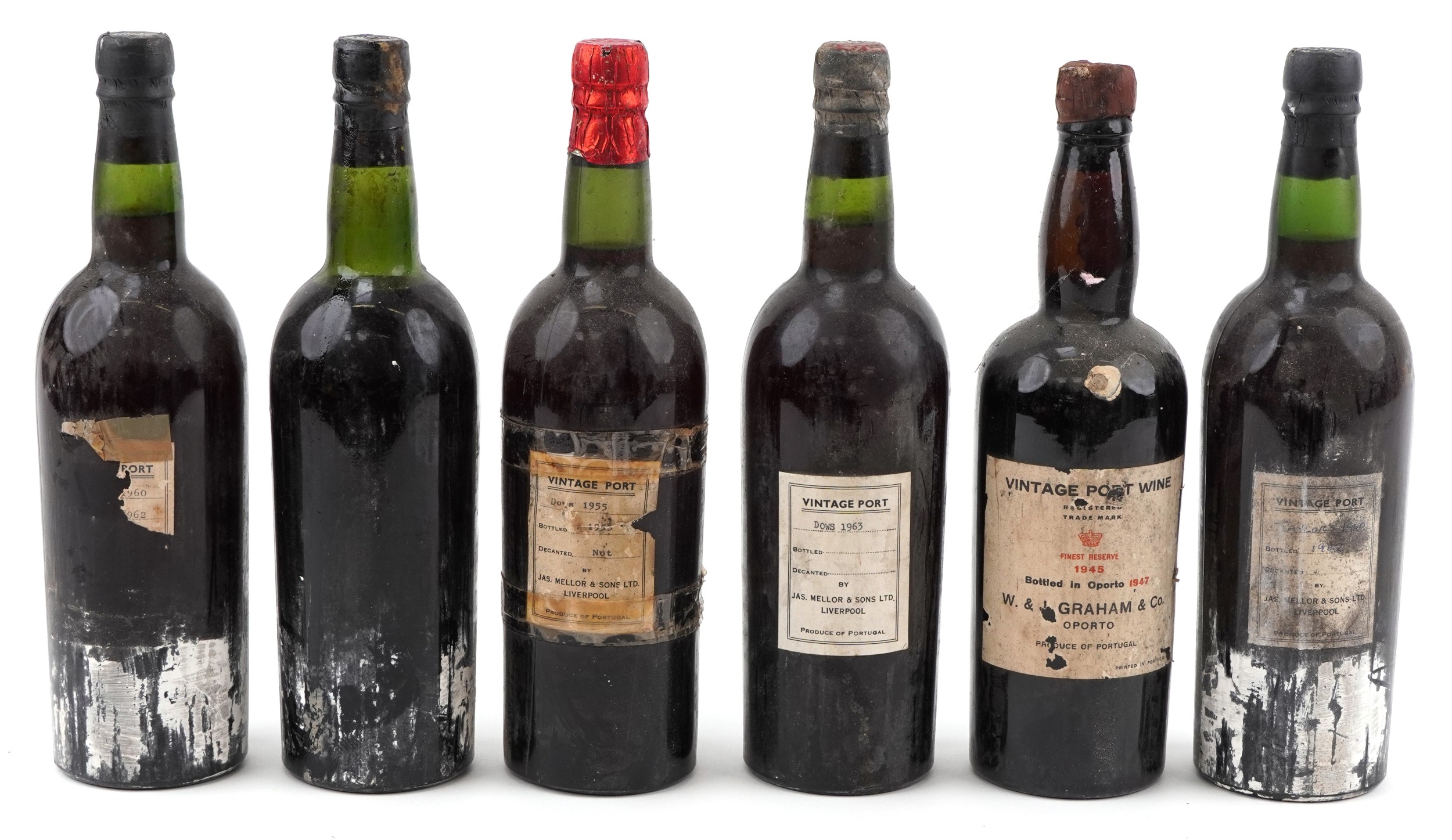
Old port can make buyers feel clever before they have checked a single shoulder. Eastbourne Auctions has a live six-bottle vintage port lot, Lot 1013, estimated at £80–£120 and described as including replacement labels for W & J Graham & Co. 1945, Dow's 1963, and Dow's 1955, backed by four verified full-size catalogue images from a 2500px family. That is enough to slow the romance down. The house names are real. So is the uncertainty. Several bottles look heavily bin-soiled, one label is almost gone, and the buying case only works if you price the doubt in before you start daydreaming about wartime Graham's at pub-money levels.
Primary live lot today
Six bottles of vintage port, some with replacement labels including W & J Graham & Co. 1945, Dow's 1963 and Dow's 1955, Lot 1013
Auction house: Eastbourne Auctions
View live lot listing
Estimate: £80–£120
Auction date displayed in listing: 23 June 2026 at 9:30am BST
Catalogue detail: mixed six-bottle lot with replacement labels referencing Graham's 1945, Dow's 1963, and Dow's 1955
Photo coverage: four verified full-size catalogue images, with the main source at 2500×1447
Why this lot is interesting
This is not a collector's-cabinet buy. It is a judgement buy. The estimate is what makes it live: six bottles carrying blue-chip vintage years at a level where a bidder can talk themselves into “worth a flutter” far too quickly. Yet the lot is also unusually honest in its warnings. Eastbourne does not pretend these are pristine cellar relics. The replacement labels are stated up front, and the photographs show exactly the sort of abrasion, grime, and mixed presentation that separates romantic old-bottle chat from the harder work of deciding whether any individual bottle still has convincing identity.
That tension is why the lot deserves attention. One bottle still carries an emphatic W & J Graham & Co. 1945 label. Others look far more compromised, with rubbed glass, partial labels, and a presentation that suggests long storage of some kind without telling you whether that storage was ideal, merely decent, or simply survivable. For a buyer who understands port, that does not automatically kill the lot. It just changes the thesis. You are no longer buying clean provenance. You are buying a cluster of old bottles whose value sits in how much of the story remains legible.
Who buys this and why
- Drinkers who already know mature port is a gamble: they are not chasing showroom condition so much as the chance that one or two bottles still drink better than the estimate implies.
- Dealers and restaurant buyers with a tolerance for imperfect stock: they may see value if the better-labelled bottles prove sound enough to justify the whole parcel.
- Collectors of old fortified-wine ephemera and cellar objects: they are buying age, house names, and period presentation as much as they are buying guaranteed liquid quality.
Where the risk sits
- Treat the replacement labels as the headline, not the footnote: once labels are replaced, you are leaning harder on bottle shape, capsule consistency, remaining print, and whatever condition report the auction house can still provide.
- Read the fill levels bottle by bottle: mature port can still be rewarding with some ullage, but mixed fills across a six-bottle lot should change what you think you are bidding on.
- Look at the capsule integrity and neck grime: dirt is not the enemy; disturbed capsules, seepage traces, and cork movement are.
- Do not let the 1945 date do all the emotional work: wartime and post-war port names are magnetic, but the bottle in front of you still has to look physically plausible.
- Ask for a condition report if you are serious: with a lot like this, a short note on levels, leakage, and whether any bottles appear damp around the cork is more valuable than another romantic paragraph about rarity.
Comparator lots
These comparators stay in the same old-port lane and help frame today's lot properly: cleaner named parcels, similar estimate brackets, and another example where the date on the label is only the beginning of the work.
- Three bottles of Dow's 1975 vintage port, Lot 1010 — Auction house: Eastbourne Auctions. Estimate: £50–£100. This is the cleaner house-specific comparator: fewer bottles, fewer headline vintages, but a tidier proposition if you would rather buy one recognisable name than a mixed puzzle. view lot
- Five bottles of vintage port with replacement labels stating Taylor's 1960, Lot 1015 — Auction house: Eastbourne Auctions. Estimate: £50–£100. This is the closest like-for-like comparator: another replacement-label gamble where the buying call depends on how much trust you place in the surviving physical evidence. view lot
- 1920 bottle of vintage port, Lot 415 — Auction house: Littleton Auctions. Estimate: No Estimate. This is the age-first comparator: older on paper than anything in today's lot, but still a reminder that extreme vintage appeal means very little if the bottle evidence is no longer calm enough to trust. view lot
UK media & culture context
Britain still reads port through ritual and inheritance, which is exactly why lots like this need discipline. The Wine Society's port guide remains useful on the category basics that matter here: vintage port is the top bottle-aged style, develops sediment, and rewards long quiet storage rather than decorative neglect. Decanter's advice on ullage is even more practical for auction buyers, because fill level is one of the few things a catalogue photograph can tell you before the cork is ever pulled. Club Oenologique has also argued, in its recent vintage-port coverage, that the category no longer belongs only to Christmas and old-club nostalgia. That matters because today's lot is not really a festive prop. It is a test of whether the buyer can separate the enduring cultural prestige of old port from the harder physical truth of these exact bottles.
- The Wine Society: The ultimate guide to Port — clear UK buying context on vintage port, sediment, storage, and why bottle condition matters so much once age becomes the selling point.
- Decanter: Ullage in wine, how important is it? — a practical UK auction-read on fill levels and why headspace becomes a serious clue with older bottles.
- Club Oenologique: The new rules of vintage port — useful modern context for how vintage port is being discussed beyond Christmas nostalgia and gentleman's-club cliché.
Bottom line
If you want certainty, buy the three-bottle Dow's comparator and sleep better. If you enjoy old-bottle ambiguity and can absorb the chance that some of this lot is more decorative than drinkable, Lot 1013 is exactly the sort of low-estimate puzzle that can reward nerve and punish sentimentality in equal measure. The sensible verdict is not “yes” or “no”. It is “only at a price that leaves room for disappointment”.
Editorial analysis for educational purposes only. Final bidding decisions, fees, tax, shipping, collection, condition confirmation, and contract terms are handled by the auction house.