Daily Deep Dive · 26 Jun 2026 · Wine & Spirits
Lot Spotlight: a Dunville's VR deck that only works if the branding beats the wear
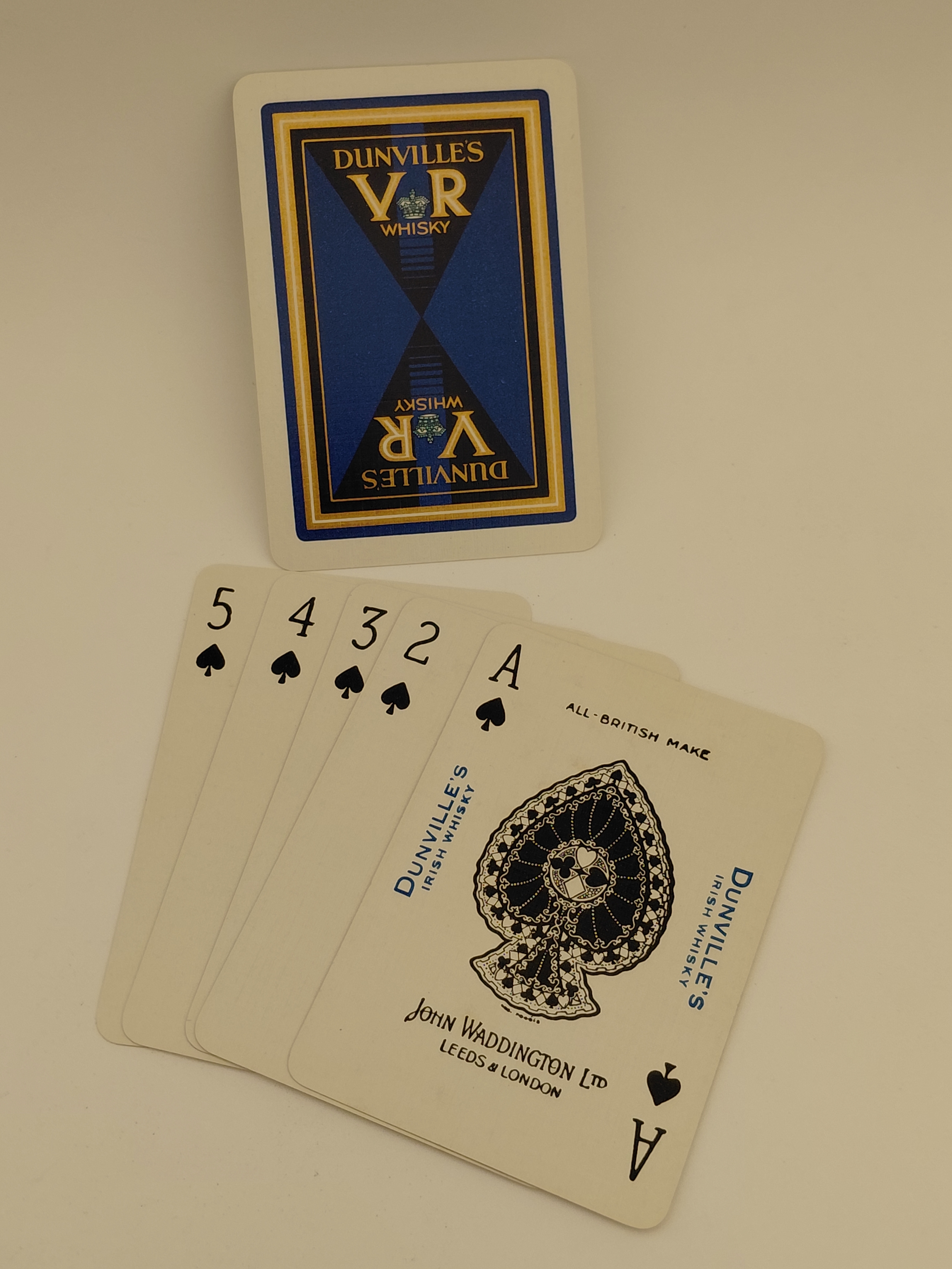
Whiskey-branded playing cards live in the awkward space between pub ephemera and serious paper collectables. On The Square Auctions has a live Dunville's VR Whiskey playing-card deck by John Waddington Ltd, Lot 442, estimated at £80–£160 and backed by three verified full-size catalogue images from a 2500×3333 family, including a spread shot that shows both the tuck box and sample cards. That is enough to make this a proper condition decision. Dunville's is a real Belfast whiskey name, Waddington is a real British card maker, and the catalogue says the set is complete and in order. The whole buying question is whether the surviving box edges, print sharpness, and card cleanliness still carry that story cleanly enough to justify collector money rather than nostalgic pub-room money.
Primary live lot today
A set of Dunville's VR Whiskey Playing Cards by John Waddington Ltd, Lot 442
Auction house: On The Square Auctions
View live lot listing
Estimate: £80–£160
Auction date displayed in listing: 27 June 2026 at 12pm BST
Catalogue detail: Dunville's VR Whiskey branded deck and cardboard tuck box, attributed to John Waddington Ltd, described as complete and in order
Photo coverage: three verified full-size catalogue images from a 2500×3333 family
Why this lot is interesting
This lot is not really about card play. It is about overlap. Belfast whiskey history, British commercial printing, and pub-adjacent branding all meet in one small box. That is what makes it stronger than ordinary novelty playing cards. Dunville's VR was one of the whiskey names that once travelled well beyond Belfast, and branded decks like this only survive in convincing form when the box has not collapsed into tat and the cards still look like an intact promotional object rather than as a bundle of loose survivors.
The estimate is also pitched in the part of the market where buyers can get lazy. £80–£160 is no longer junk-box territory, but it is still cheap enough for someone to bid on the name alone. That is the trap. If the tuck box has gone soft, corners are blown, staining is heavy, or the deck has been quietly made up from mixed replacements, the romance disappears fast. If the box remains structurally decent and the cards read as one coherent branded set, this becomes a compact and genuinely displayable piece of Belfast whiskey history.
Who buys this and why
- Irish whiskey memorabilia collectors: they are buying the Dunville's name as a surviving piece of brand history, not as a functioning game night deck.
- Paper-ephemera and advertising collectors: they care about print quality, typography, box survival, and whether the object still reads as a complete commercial design.
- Belfast-history buyers and bar-interior stylists: they want a small, legible object with local identity that can sit in a cabinet, frame-up display, or drinks-room scheme without taking over the room.
What to inspect in the photos
- Read the tuck box as hard as you read the cards: edge knocks, softened corners, grime, and lid fatigue matter because the box is half the object here.
- Check that the branded back design stays crisp and even: rubbing through the dark blue ground or gold-tone print will hurt display value much faster than a little honest age.
- Look closely at the exposed card faces for foxing, corner blunting, and mixed-age replacements: the catalogue says complete and in order, but the photographs still need to support that claim.
- Use the Waddington reverse shot properly: the maker attribution is useful, but it also gives you the clearest evidence for how much handling and shelf wear the box has taken.
- Ask whether jokers or ancillary inserts survive if that matters to you: a collector may be satisfied by a complete standard deck, but completeness can mean slightly different things once card ephemera moves beyond ordinary play use.
Comparator lots
These comparators stay in the same whiskey-brand ephemera lane and help frame whether today's deck is a design-object buy, a Belfast-history buy, or simply the cheapest way into Dunville's collectables.
- Dunville's Special Liqueur Playing Cards, Lot 440 — Auction house: On The Square Auctions. Estimate: £80–£160. This is the closest like-for-like comparator in the same sale: another Dunville's deck, another complete card set, but with clearer box wear and a more overtly fragile paper case. view lot
- A clear glass etched with 'DUNVILLE'S VR OLD IRISH WHISKY BELFAST' and a crown motif, Lot 638 — Auction house: On The Square Auctions. Estimate: £80–£120. This is the same-brand comparator in a different material: glass rather than paper, but the same test of whether branded survival and Belfast identity are enough to carry the estimate. view lot
- A framed advertising mirror for D.W.D Whisky, Lot 432 — Auction house: On The Square Auctions. Estimate: £400–£800. This is the step-up display comparator: much larger money, much larger wall impact, and a useful reminder that whiskey branding gets expensive fast once the object moves from pocket-scale ephemera into full-room statement territory. view lot
UK media & culture context
This little deck lands in a category that British and Irish buyers increasingly treat as heritage design rather than as pub junk. Dunville's own history material is useful here because it sets the brand back in nineteenth-century Belfast, when Royal Irish Distilleries was producing at industrial scale and the company's reach spilled well beyond bottles into the city's wider identity. The Irish News has also made the bigger cultural point clearly: Belfast is finally starting to retell its whiskey story, with Dunville's back on shelves and back in local historical conversation. That makes branded survivals like this more interesting than generic ad decks. Add Waddington's on the other side of the object and you get another recognisable British story: a major UK playing-card producer whose boxes and court designs still anchor a lot of twentieth-century domestic card culture. In other words, this lot works best when you see it as a crossover between whiskey history and British print culture, not as a novelty deck with a drinks logo on it.
- Echlinville Distillery: Dunville's — a solid brand-history source on Dunville's Belfast origins, the Royal Irish Distilleries, and the modern revival of the label.
- The Irish News: Recalling Belfast's 'hidden' Irish whiskey heritage — useful local context on why Dunville's still matters in Belfast and how the city's whiskey history is being retold.
- The World of Playing Cards: Waddington's Playing Cards — practical maker context for judging why a Waddington-attributed branded deck sits in a stronger collecting lane than anonymous promotional cards.
Bottom line
If you collect whiskey history, this is the sort of lot that earns its keep by being small, legible, and specific. Bid if the box still feels structurally honest and the exposed cards look convincingly of one set. If the real attraction is only the Dunville's name, the branded glass comparator is probably the cleaner buy. The deck works when the paper still has authority.
Editorial analysis for educational purposes only. Final bidding decisions, fees, tax, shipping, collection, condition confirmation, and contract terms are handled by the auction house.