
Daily Deep Dive · 29 Jun 2026 · Furniture
Lot Spotlight: a Damascus cabinet that has to hold its geometry before it earns the romance
Some furniture only has to look pleasant from across the room. This does not. Wotton Auction Rooms has a live Damascus inlaid display cabinet in the Moorish style, Lot 576, estimated at £600–£800 and backed by eight verified full-size catalogue images from a 2048px-tall family, with the lead source at 1156×2048. That is enough to treat it as a real cabinet decision rather than as an atmospheric prop. The catalogue says Syrian, c1900, with mixed-wood, bone, and mother-of-pearl inlay. The buying question is whether the cabinet still reads as one disciplined vertical object, or whether the shimmer is doing too much work for tired structure, patchy restoration, and losses you will only start counting once it is standing in your own light.
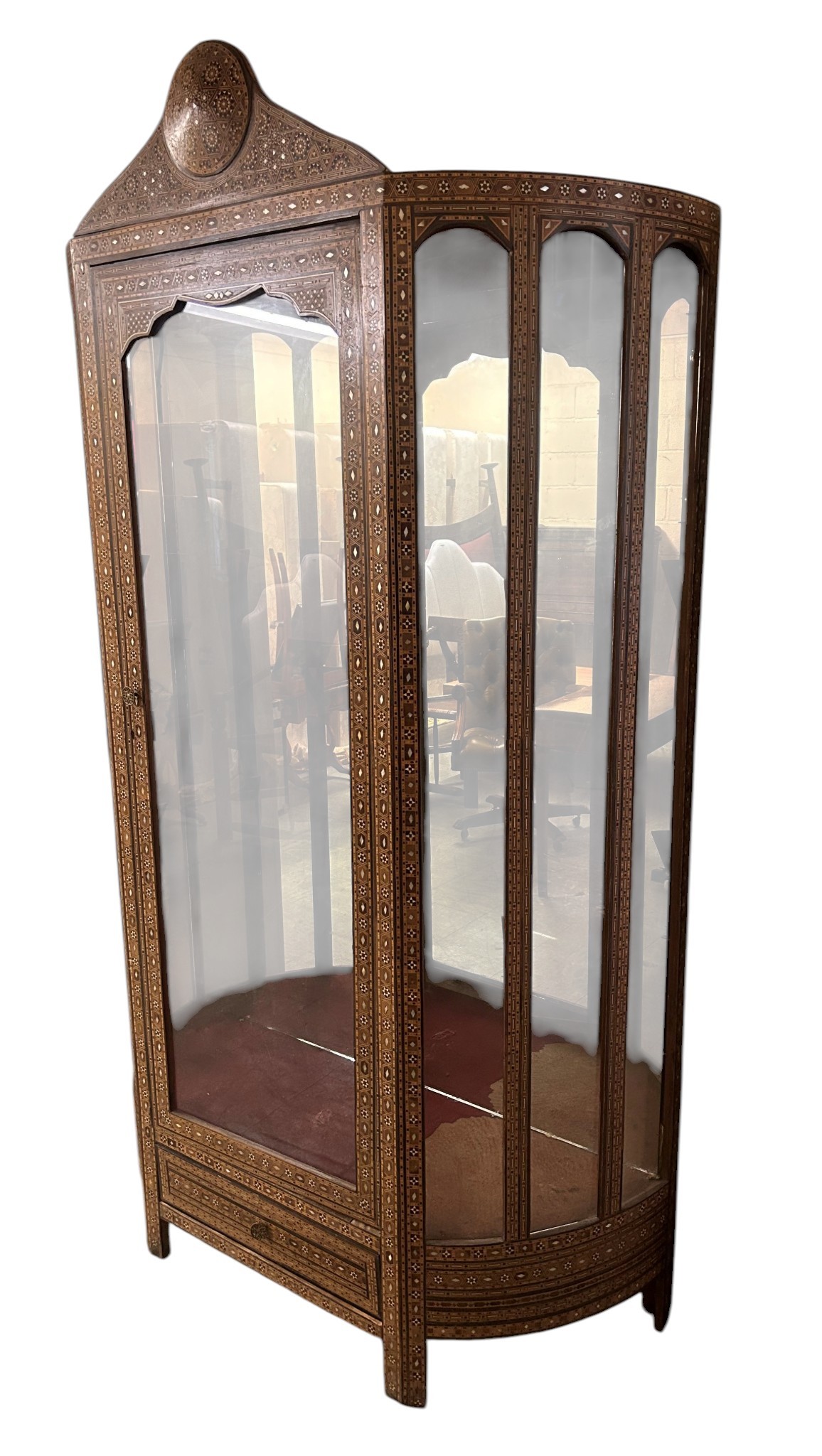
Primary live lot today
Damascus inlaid display cabinet in the Moorish style, Lot 576
Auction house: Wotton Auction Rooms
View live lot listing
Estimate: £600–£800
Auction date displayed in listing: 30 June 2026 at 10am BST
Catalogue detail: an impressive Syrian c.1900 display cabinet with mixed-wood, bone, and mother-of-pearl inlay, shelved interior, and a catalogue description giving 215 cm high and 123cm deep
Photo coverage: eight verified full-size catalogue images from a 2048px-tall family, with the lead source at 1156×2048
Why this lot is interesting
This is the kind of cabinet that pulls two markets together at once. Decorative-furniture buyers see instant theatre: height, shimmer, archwork, and enough surface pattern to anchor a room without needing anything else around it. More serious buyers see a harder question. Cabinets in this lane are expensive to fake well and equally expensive to repair badly. Once bone and mother-of-pearl losses start getting filled, once doors lose their line, or once the carcass stops standing square, the object stops being an interior statement and starts becoming a restoration project with excellent lighting.
What makes this Wotton lot worth attention is that the photography is strong enough to let you slow the romance down. Eight images is generous by furniture standards. You can read the front elevation, the side movement, the inlay density, the shelf rhythm, and at least some of the stress points where the cabinet has to prove it is still more than a dazzling skin. The estimate is not giveaway money, but it is still low enough that buyers could convince themselves the hard part has already been done by the decoration. It has not. The cabinet still has to stand up, align properly, and survive close looking.
Who buys this and why
- Collectors of Islamic and Levantine decorative furniture: they are buying workshop discipline, materials, and survival, not just a broadly exotic silhouette.
- Interior buyers furnishing one decisive wall: they want a single piece that can bring scale, pattern, and a museum-house mood without needing a whole matched suite.
- Dealers and decorators working the crossover market: they know cabinets like this can sell to both furniture buyers and art-object buyers if the structure stays honest enough to carry the ornament.
Condition pressure points
- Read the central door and pediment as one continuous line: if the cabinet has moved, the geometry around the opening usually tells on it before the rest of the case does.
- Look for missing, darkened, or overfilled inlay: bone and mother-of-pearl should read as crisp punctuation, not as a patchwork of replacements with different tone and reflectivity.
- Use the side and oblique views to judge stance: a tall cabinet can photograph flatter than it stands, so you are checking for lean, twist, and whether the base still looks settled.
- Study the shelved interior and glazing: shelves, door closure, and any waviness around the glazed section matter because decorative confidence falls apart quickly if the practical cabinet bits are tired.
- Ask Wotton Auction Rooms to confirm the full dimensions and any restoration: the catalogue line gives height and depth but not a clean width reading, which is exactly the sort of small ambiguity worth clearing before you bid on a 215cm statement piece.
Comparator lots
These comparators stay in the display-cabinet lane but test different buying logics: craftsmanship-led inlay, branding-led shop display, and plain glazed utility. That helps frame what Wotton's £600–£800 estimate is really asking you to pay for.
- A late 19th century Austrian mahogany and mother-of-pearl inlaid display cabinet bookcase — Auction house: Swan Fine Art. Estimate: £50–£100. This is the low-estimate inlay comparator: still decorative, still glazed, but in a far humbler cabinet form, which helps show how much of today's price sits in scale, complexity, and theatrical front elevation rather than inlay alone. view lot
- A scarce Edwardian mahogany shop counter top cigarette display or advertising cabinet — Auction house: Wotton Auction Rooms. Estimate: £300–£500. This is the same-sale function comparator: smaller, more commercial, and driven by branding rather than Syrian inlay, which is useful because it shows how quickly display furniture value shifts once the story becomes craftsmanship instead of retail nostalgia. view lot
- A mid 20th century glazed mahogany shop counter display cabinet — Auction house: Bearnes Hampton & Littlewood. Hammer: £90. This is the plain-utility comparator: same broad room function, almost none of the decorative burden, and a good reminder that buyers are not paying merely for shelves behind glass. They are paying for an object that has to justify its ambition. view lot
UK media & culture context
This cabinet lands in a British collecting story that is older than a lot of buyers remember. Leighton House in Kensington is still the cleanest local reference point. Its Arab Hall was built from the late 1870s out of the same Victorian appetite for Middle Eastern interiors, and the museum's own background material makes clear how directly Leighton and George Aitchison were looking at Damascus among other cities when shaping that room. The V&A's history of its Damascus Room pushes the point further: by 1880 the museum was already acquiring Syrian interiors and treating them as serious artistic environments rather than as curiosities. Country Life's March 2026 coverage of the new Arab Hall exhibition is useful because it shows the British appetite has not disappeared; it has just shifted from imperial collecting swagger toward design-history reverence. That is why this Wotton cabinet works best when judged as a real piece of furnishing architecture, not as a shorthand for vaguely oriental glamour.
- Leighton House: Q&A on the Arab Hall — direct museum context for how Damascus and related Middle Eastern interiors shaped one of Britain's best-known decorative rooms.
- V&A Blog: A room from Damascus — strong background on how the V&A acquired and interpreted Syrian domestic interiors from the late 19th century onward.
- Country Life: the Arab Hall at Leighton House — a current UK media reference showing this design language is still very much alive in British heritage and interiors conversation in 2026.
Bottom line
Bid if you want a cabinet that can genuinely command a room and the structure looks as controlled as the surface is busy. Walk away if the front geometry is wavering, the inlay starts reading as repair camouflage, or the dimensions turn out to be muddier than the catalogue suggests. A piece like this earns its money when the architecture still beats the glitter.
Editorial analysis for educational purposes only. Final bidding decisions, fees, tax, shipping, collection, condition confirmation, and contract terms are handled by the auction house.