
Daily Deep Dive · 30 Jun 2026 · Ceramics
Lot Spotlight: a low-estimate Shelley trio where the pair has to do the real work
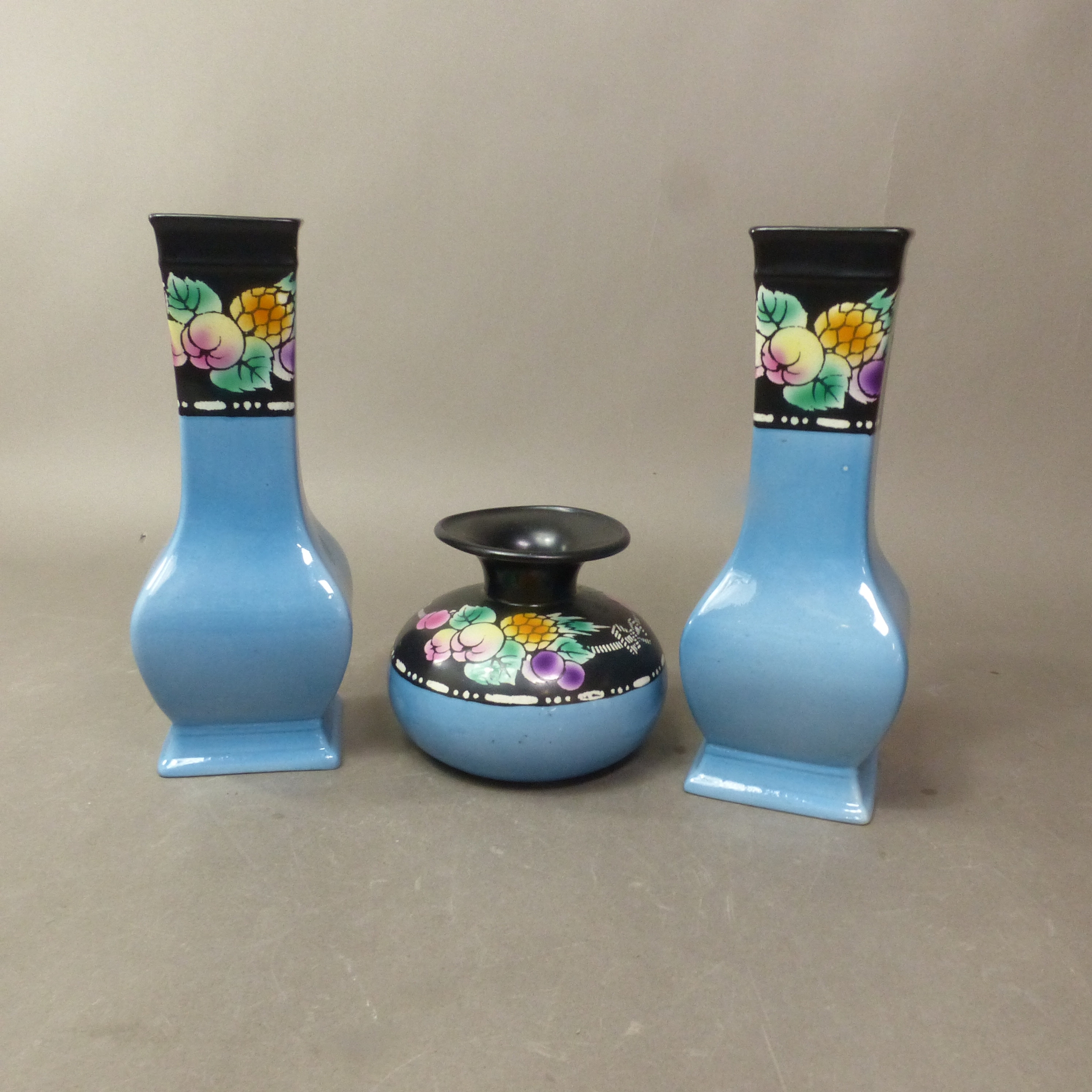
Art Deco ceramics can look sorted long before they are actually convincing. Potteries Auctions Ltd has a live Shelley group, Lot 186, estimated at £25–£50 and shown in a verified 2500×2500 full-size catalogue image. Two tall vases carry the real decorative weight, while the squat companion piece is there to sweeten the arrangement rather than define it. That makes this a cheap but not careless ceramics decision. The useful question is whether the tall blue vases still read as a genuine pair with enough symmetry, clean black banding, and tidy colour to justify buying the group as a room-ready Deco statement rather than as three pleasant odds and ends that happen to photograph well together.
Primary live lot today
A pair of Shelley Art Deco period vases with a matching squat vase, Lot 186
Auction house: Potteries Auctions Ltd
View live lot listing
Estimate: £25–£50
Auction date displayed in listing: 3 July 2026 at 10am BST
Catalogue detail: a pair of Shelley Art Deco period vases decorated in a turquoise glaze with a fruit on black border, height 17.5cm, together with a squat vase in the same pattern (3)
Photo coverage: one verified full-size catalogue image, with the downloadable source at 2500×2500
Why this lot is interesting
This is a decorator's lot pretending to be a casual mixed group. The estimate is modest, the arrangement is immediately legible, and the colour story does a lot of work fast: powder blue bodies, black shoulders, and fruiting decoration that gives the set a slightly theatrical 1930s punch without turning sugary. That is exactly why it deserves a closer look. Plenty of inexpensive Art Deco pottery sells because one strong shape hides two weaker companions. Here the buying logic only works if the tall vases really behave as a pair and if the central squat vase reads as a proper design accent rather than as a filler item that makes the photograph feel more abundant than the object actually is.
Shelley matters because it sits in one of the cleanest British collecting lanes for interwar ceramics: recognisable name, Stoke pedigree, and decoration that still works in contemporary rooms. But the maker alone is not enough. This is not rare museum-level Shelley, and the estimate tells you so. The attraction is the ensemble. If the silhouettes are properly matched, the painted fruit stays crisp, and the black borders are not hiding rubbing or restoration, it becomes an easy low-stakes buy for someone who wants real British Art Deco energy without paying premium-motif money.
Who buys this and why
- Art Deco interior buyers: they want a ready-made mantel or shelf grouping with enough geometry and colour contrast to organise a corner quickly.
- Shelley collectors buying below trophy level: they are looking for a recognisable factory name and period feel at an estimate that still leaves room for condition tolerance.
- Dealers and stylists working affordable British ceramics: they know paired forms sell better than singles when the symmetry feels intentional and the palette still pops in daylight.
Where the risk sits
- Treat the two tall vases as the test, not the trio as a whole: check whether neck height, shoulder swell, and foot proportions genuinely match, because near-pairs are less useful than real pairs.
- Read the black banding hard: on pottery like this, rubbed borders, overpainting, and retouching often show first where dark ground meets bright fruit decoration.
- Look for stress around the narrow necks and square feet: those are the pressure points most likely to chip, nick, or show old knocks once the lot leaves the catalogue lights.
- Ask Potteries Auctions Ltd for backstamp and rim photos: the single catalogue view is high-resolution but front-facing, so you still need confirmation on marks, base wear, and whether all three pieces are equally clean at the edges.
- Price the squat vase correctly: it should feel like a bonus note in the arrangement. If you find yourself needing it to justify the buy, the pair may not be strong enough on its own.
Comparator lots
These comparators stay inside the British decorative-pottery lane and show how quickly value shifts when the market moves from group impact to maker clout, trial status, or a simpler paired format.
- Pair of early 20th century vases, likely produced by Thomas Forester & Sons, height 27cm (2) — Auction house: Potteries Auctions Ltd. Estimate: £35–£70. This is the closest paired-form comparator in the same sale: less overtly Deco, less brand-recognisable than Shelley, but a useful check on how much today's estimate is paying for period style rather than just owning two tall vases. view lot
- A Moorcroft limited edition vase in the Passion Fruit design by Kerry Goodwin — Auction house: Potteries Auctions Ltd. Estimate: £60–£120. This is the maker-premium comparator: one later Moorcroft piece with factory assurance and a limited-edition hook, showing how quickly the price moves once the market prioritises named pattern and factory status over decorative grouping. view lot
- A Moorcroft trial vase in the Carp Tail Dance design by Kerry Goodwin — Auction house: Potteries Auctions Ltd. Estimate: £60–£120. This is the status comparator: a smaller object, but one carrying the word trial and a clearer collector story, which helps underline that Shelley's attraction here is the room effect of the trio rather than specialist scarcity. view lot
UK media & culture context
Shelley only makes sense when you remember where it came from. The Potteries local-history record traces the firm back through Wileman & Co at Foley and shows how firmly Shelley sat inside the Stoke-on-Trent china trade rather than outside it as some isolated style house. That matters because this lot is not just colourful pottery. It is part of the Longton story in which shape, transfer, and decorative fashion all had to be scaled for a broad market. The V&A's own writing on Art Deco is a useful second lens: the movement was built on modern surface impact, stylised geometry, and accessible glamour, which is exactly the lane this trio is trading in. The collecting culture is still alive as well. Antiques Trade Gazette's guide to societies and collectors' clubs notes the Shelley Group, formed in 1986 to research and promote the pottery's output, which is a good reminder that buyers are not just shopping for blue ornaments. They are stepping into a durable British collector conversation about Shelley, Wileman, pattern, and period feel.
- The Potteries: Shelley Potteries Works, Foley, King Street, Fenton — direct Stoke-on-Trent factory context for Shelley's place in the local ceramics trade.
- V&A Blog: The kaleidoscopic wonder of Art Deco prints — a concise museum explanation of the broader Art Deco visual language that helps explain why this palette and silhouette still land so well in interiors.
- Antiques Trade Gazette: Guide to societies and collectors' clubs — includes the Shelley Group and shows the maker still has an organised UK collecting base.
Bottom line
This is a buy for someone who wants cheerful British Deco with just enough factory-name comfort to stop it feeling anonymous. Bid if the two tall vases are genuinely well-matched and the black shoulders stay crisp under closer scrutiny. If the pair turns out to be only loosely matched or the decoration is doing too much work for edge wear, leave it and put the money toward one stronger Moorcroft instead. The estimate only makes sense if the pair still behaves like a pair.
Editorial analysis for educational purposes only. Final bidding decisions, fees, tax, shipping, collection, condition confirmation, and contract terms are handled by the auction house.