
Daily Deep Dive · 03 Jul 2026 · Ceramics
Lot Spotlight: a Shelley tea set that only works if the count stays honest
Tea services sell on atmosphere first and arithmetic second. Potteries Auctions Ltd has a live Shelley Dainty Blue double tea set, Lot 555, estimated at £100–£200 and backed by a verified 2500×1875 catalogue image family. The pattern is easy to like. The useful work starts once you stop admiring the blue border and begin counting what is actually there, how consistently it matches, and whether the set still reads as one calm British tea-table proposition rather than as a handsome accumulation with a few quiet substitutions hiding in plain sight.
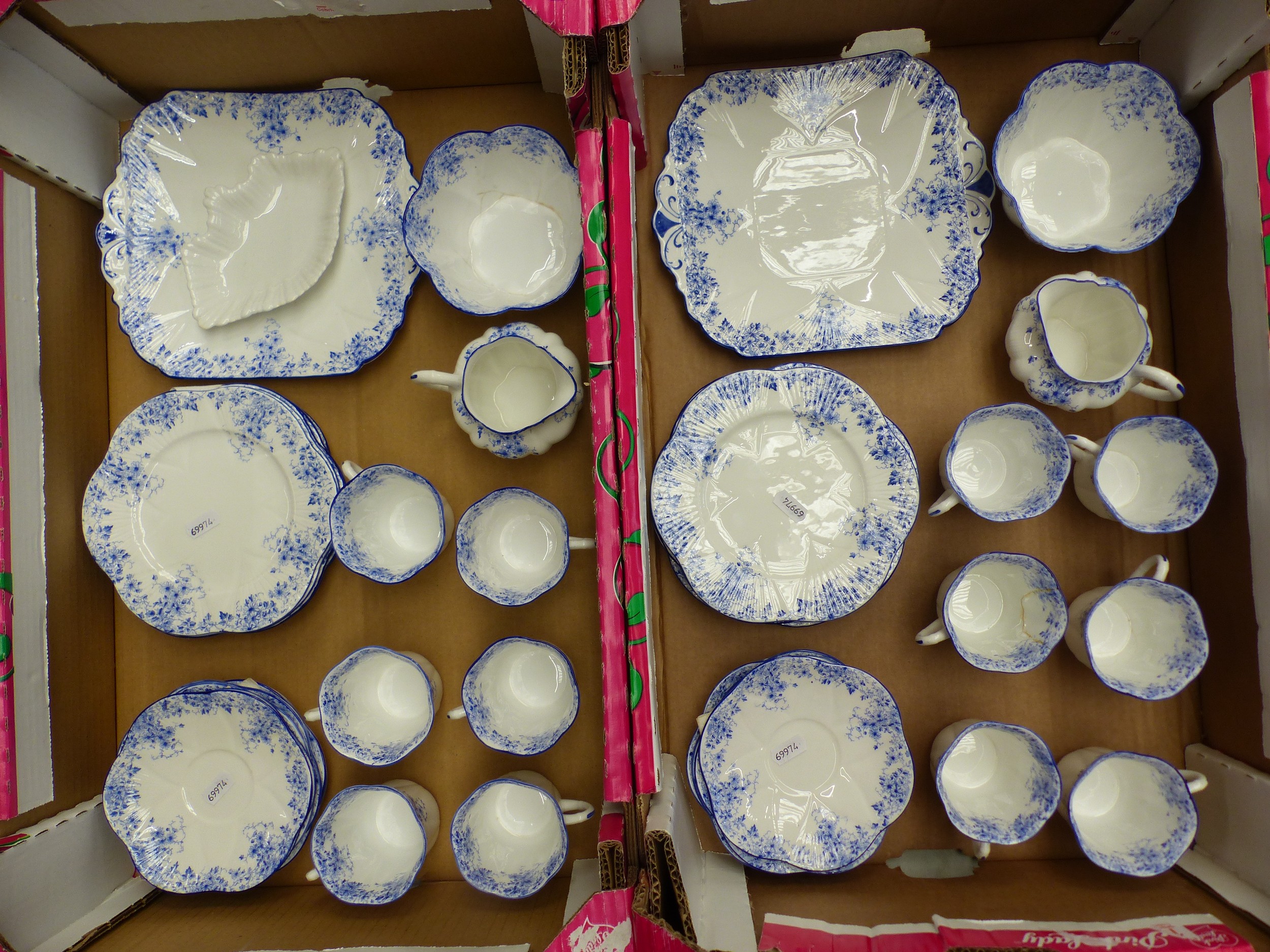
Primary live lot today
Shelley Dainty Blue double tea set, Lot 555
Auction house: Potteries Auctions Ltd
View live lot listing
Estimate: £100–£200
Auction date displayed in listing: 3 July 2026 at 10am BST
Catalogue detail: Shelley Dainty Blue double tea set, 2 twin handled cake plates, 2 milk jugs, 2 open sugar bowls, 12 tea trios, pattern number 051/28, together with a small Shelley shaped pin dish (43pcs)(2 trays)
Photo coverage: three verified full-size catalogue images, with the lead source at 2500×1875
Why this lot is interesting
This is the sort of Shelley lot that can look richer than it is if you let the pattern do the persuading. Dainty Blue remains one of those English table services that reads as effortlessly correct from across the room: blue floral border, neat white field, and enough repetition to make a tea table feel organised before a single cup is filled. The attraction here is not rarity theatre. It is usability. Forty-three pieces is enough service for someone who actually entertains, stages interiors, or wants one coherent run of British china rather than a shelf of isolated pretties.
That is also the risk. Big services stop being attractive the moment the count turns ragged. One replacement cup, one different blue tone, or one stack of saucers with heavier wear can push the whole set from composed to compromised. Shelley has a loyal collector base and a real Stoke-on-Trent pedigree, but this is not a buy made on factory name alone. It is a buy made on whether the service still behaves as a service. If the trio counts, cake plates, jugs, bowls, and pin dish still all belong to the same visual sentence, the estimate is live. If they do not, you are paying for a story about completeness rather than the thing itself.
Who buys this and why
- Tea-table collectors: they want a service large enough to use properly, not just a cabinet sample with one cup and one plate.
- Interior buyers furnishing a kitchen or dining room: they are buying pattern continuity, display rhythm, and the soft authority of real British tableware.
- Dealers who understand replacement economics: they know a complete, visually consistent service is easier to sell than a nominally larger lot with quiet mismatches and tired gilding.
What to inspect in the photos
- Count against the description: the lot only works if the 12 tea trios, pair of cake plates, pair of milk jugs, pair of sugar bowls, and extra pin dish all actually show up in the image set without obvious omissions.
- Compare the blue border tone across stacks: services assembled over time can drift slightly in colour or print sharpness, and grouped photography often softens that problem.
- Read the gilding and rim edges hard: tea wares tell the truth at the rims, cup handles, and saucer wells long before they tell it anywhere else.
- Check for shape consistency: if one or two cups sit differently, flare differently, or carry a different handle profile, you are looking at an interruption in the service rather than a tidy 43-piece set.
- Ask Potteries Auctions Ltd for backstamp and underside views if you want to bid strongly: the catalogue images are clear enough for layout judgement, but not enough to settle every question about pattern consistency, wear, or later replacement.
Comparator lots
These comparators stay in the Shelley tableware lane but shift the format, scale, or buying motivation so you can see what today's estimate is really paying for.
- Art Deco design Shelley “Garden Urn” six-piece coffee can set, coffee pot and sugar pot, Lot 299 — Auction house: Three Bridges Auction House. Estimate: £100–£200. This is the closest live style comparator outside today's sale: fewer pieces, more obvious Art Deco punch, and a cleaner display proposition than a full tea service. It helps show how much of Lot 555's estimate sits in quantity and completeness rather than rarity alone. view lot
- Shelley China Art Deco-style yellow floral design with grey leaves, Lot 364 — Auction house: Potteries Auctions Ltd. Estimate: £30–£60. This is the low-count comparator inside the same maker lane: one smaller decorative Shelley decision versus a full working service. It is useful because it reminds you that today's lot is really a table set buy, not a motif buy. view lot
- Shelley porcelain teacup and saucer, no. H1544/36, Lot 670 — Auction house: Potteries Auctions Ltd. Estimate: £40–£80. This is the single-place-setting comparator. It shows how the market prices one more ornate Shelley tea object when the buyer is chasing decoration and gilding rather than service completeness. view lot
UK media & culture context
This lot belongs to a very British overlap: Stoke factory history on one side, tea-table ritual on the other. The Potteries record places Shelley firmly inside the Foley and Longton china trade, which matters because Dainty Blue is not floating free as generic vintage prettiness. It comes out of a recognisable Staffordshire manufacturing story. The National Trust's history of tea is the second half of the picture. Afternoon tea became part of British middle-class domestic life in the 19th century, and services like this still trade on that lingering social script: ordered table, matching china, and a sense that hospitality should look composed. The collector culture is still present too. Antiques Trade Gazette's societies guide notes the Shelley Group, formed in 1986 to research and promote the pottery, which helps explain why even relatively usable Shelley still gets more serious attention than anonymous blue-and-white tea wares.
- The Potteries: Shelley Potteries Works, Foley, King Street, Fenton — direct Stoke-on-Trent context for the firm behind Shelley tablewares.
- National Trust: The history of tea — useful context for why complete tea services still carry such a strong domestic and cultural charge in Britain.
- Antiques Trade Gazette: Guide to societies and collectors' clubs — includes the Shelley Group and confirms the maker still sits inside an active UK collecting ecosystem.
Bottom line
This is a sensible buy if you want one usable, room-ready Shelley service and the set still counts cleanly under closer scrutiny. Bid if the blue border tone stays consistent, the trios really are trios, and the rim wear looks even rather than patchy. Walk away if you start spotting replacements or if the best thing about the lot turns out to be the phrase “43 pieces” rather than the service those pieces are supposed to make.
Editorial analysis for educational purposes only. Final bidding decisions, fees, tax, shipping, collection, condition confirmation, and contract terms are handled by the auction house.