
Daily Deep Dive · 24 Aug 2026 · Ceramics
Lot Spotlight: a Moorcroft griffin jar that only works if the theatre stays disciplined
Modern Moorcroft can turn gaudy very quickly when the pattern shouts louder than the pot. Gorringe's has a live Vicky Lovatt for Moorcroft ‘Dance of the Griffin’ limited edition ginger jar and cover, Lot 1295, estimated at £200-£300 and backed by four verified catalogue images, with the local hero saved from a 2500x3333 full-size image family. That gives buyers enough to judge the real proposition: not just a fantasy-creature design on a dark ground, but a 25cm lidded object whose value rests on crisp tubelining, settled gilding, and a lid-body relationship that still feels exact rather than approximate.
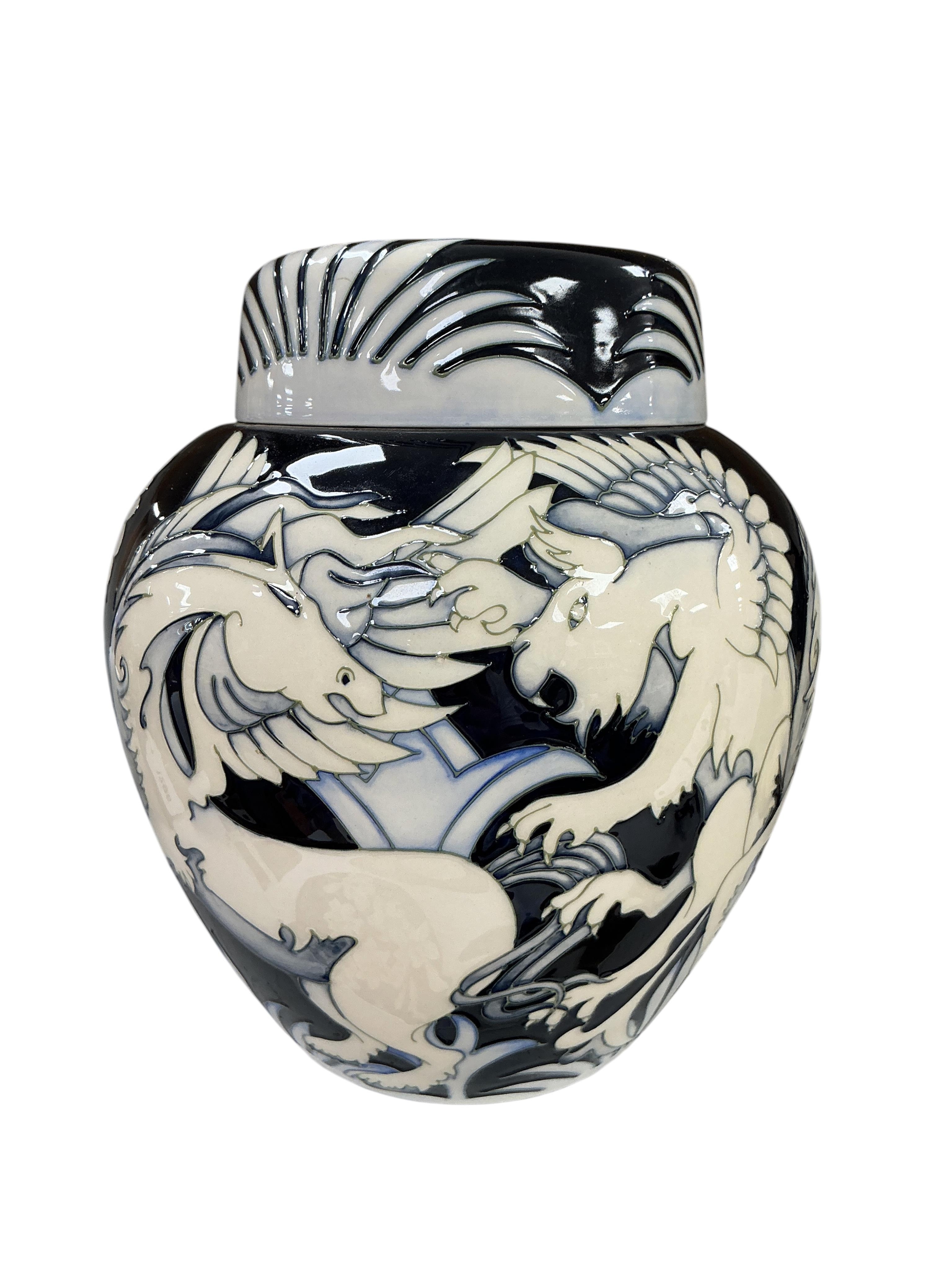
Primary live lot today
Vicky Lovatt for Moorcroft ‘Dance of the Griffin’ limited edition ginger jar and cover, signed dated 2011, Lot 1295
Auction house: Gorringe's
View live lot listing
Estimate: £200-£300
Sale window shown in the listing: 24 Aug 2026, 10:00 to 23:59:59
Catalogue title: Vicky Lovatt for Moorcroft a ‘Dance of the Griffin’ limited edition ginger jar and cover, signed dated 2011, height 25cm
Photo coverage: four verified catalogue images, with the post hero saved locally from the 2500x3333 full-size `.JPG` and a separate 500x500 preview asset for homepage use
Why this lot is interesting
This jar lands in a stronger buying lane than a lot of modern Moorcroft because it is asking for one clear judgement, not three muddled ones at once. The shape is substantial enough to matter on a shelf, the subject is specific enough to feel like a designed object rather than factory wallpaper, and the 2011 date puts it squarely in the later designer-led period that collectors often separate from the older MacIntyre and Walter Moorcroft story. If you like post-war and contemporary Moorcroft, this is the sort of piece that proves the factory could still produce drama without losing line control.
The four-image set helps. You get enough frontal and side information to test whether the griffin motif keeps its authority around the shoulder and whether the cover feels born to the body rather than merely paired with it. That is the useful difference at this estimate. Plenty of modern decorative pottery can charm in one catalogue angle. Better Moorcroft still reads as a coherent object when you start asking boring questions about symmetry, lid fit, glaze stability, and how the dark ground holds up under light.
Who buys this and why
- Contemporary Moorcroft collectors: they want named-designer factory pieces with enough scale and pattern confidence to stand apart from the smaller bowl-and-coaster end of the market.
- Interiors buyers who need one theatrical ceramic rather than a shelf of china: they are paying for silhouette, lid, and colour density, provided the object still looks composed up close.
- Secondary-market buyers comparing auction value against specialist retail pricing: they will accept a bold decorative subject if the condition is calm and the estimate stays below the level where modern Moorcroft starts competing with its own dealer network.
Condition pressure points
- Start with the lid-seat: chips and grinding around the cover rim matter more than a tiny foot rub, because a ginger jar stops feeling premium the moment the lid fit looks nervous.
- Read the gilded detailing with suspicion: fantasy subjects often rely on bright metallic highlights, so rubbed gilt can flatten the whole design faster than buyers expect.
- Check the dark ground for scratches and glaze disturbance: darker Moorcroft bodies show handling more readily, especially around the shoulder where lids are lifted and replaced.
- Look for consistency in the tubelining: the raised lines should feel deliberate and even, not soft or smeared where the design needs crisp edges to keep its authority.
- Ask for clear base confirmation if needed: the design attribution, factory marks, and dated signature are part of the value story here, so make sure they are legible and not obscured by stickers or later wear.
- Do not ignore restoration risk on the knop and rim: lidded pots invite small repairs in exactly the spots a quick front photo can disguise.
Comparator lots
These three comparators stay in the same Gorringe’s Moorcroft cluster, which is useful because the buyer is comparing closely related contemporary factory pieces under the same fees, the same photography style, and the same day’s competition.
- Moorcroft Blackwell ginger jar depicting a peacock, designed by Nicola Slaney, Lot 1301 — Auction house: Gorringe's. Estimate: £80-£120. This is the nearest like-for-like shape comparator. It shows how much extra weight today’s lot is asking buyers to place on size, drama, and designer-led presence rather than simply on the ginger-jar format. view lot
- Moorcroft Shoal ginger jar designed by Sian Leeper, Lot 1304 — Auction house: Gorringe's. Estimate: £80-£120. This is the calmer comparator. If the Shoal jar is the cooler, more decorative-room version of modern Moorcroft, the Griffin jar has to justify why its heavier theatre deserves the bigger estimate. view lot
- Moorcroft ‘Shepherds Delight’ vase, Lot 1307 — Auction house: Gorringe's. Estimate: £60-£80. This is the compact-form comparator. It helps show how sharply value moves once modern Moorcroft gains a lid, extra scale, and a pattern that is selling atmosphere rather than just colour. view lot
UK culture context
Moorcroft still matters because it sits inside a specifically Stoke story rather than a vague “British pottery” blur. The Potteries Heritage Society notes that the factory continues to operate from its original Stoke-on-Trent site with its own Grade II listed bottle oven, museum, and heritage visitor centre. Visit Stoke keeps Moorcroft on its ceramics trail for the same reason: it is one of the names that still makes the city’s craft identity legible to visitors, not just to collectors. That context sharpens the appeal of today’s lot. A modern Moorcroft jar like this is not pretending to be Edwardian rarity. It is selling the survival of a place, a technique, and a designer-driven decorative tradition into the 21st century.
That story has become more charged since the brand’s recent turbulence. The BBC reported in September 2025 that production at Moorcroft restarted at the original Cobridge site after the company’s earlier collapse and return to family ownership. Buyers do not need to turn every post-2000 jar into a rescue-narrative trophy, but they should recognise that the secondary market now reads these later designer pieces a little differently. They are not just pretty shelf objects. They are part of a living Stoke-on-Trent pottery story that has looked fragile enough for collectors to pay closer attention.
- Potteries Heritage Society: Moorcroft — useful on the factory’s original Cobridge site, bottle oven, and why Moorcroft still occupies a distinct place in Stoke ceramic history.
- Visit Stoke: Moorcroft Heritage Visitor Centre — confirms Moorcroft’s live visitor-facing place in Stoke-on-Trent’s ceramics culture rather than as a purely historical brand.
- BBC News: Moorcroft pottery boss “emotional” as work in Stoke-on-Trent restarts — a concise recent UK media reference on the factory’s collapse, restart, and continued symbolic weight in The Potteries.
Bottom line
This is one of those modern Moorcroft lots where the estimate is not outrageous, but it is demanding standards. Four images and a 2500x3333 hero give bidders enough to see the shape, the lid, and the pattern authority, and the Gorringe’s comparator group makes the price ladder unusually easy to read. If the cover sits snugly, the gilding is still fresh, and the dark ground stays cleaner in person than it often does in older homes, the lot makes sense as a confident contemporary Moorcroft statement piece. If the drama is doing all the work and the finish looks tired, the cheaper peacock or Shoal jars become the saner buys.
Editorial analysis for educational purposes only. Final bidding decisions, fees, tax, shipping, collection, condition confirmation, and contract terms are handled by the auction house.