
Daily Deep Dive · 27 Aug 2026 · Wine & Spirits
Lot Spotlight: a shelf of whisky miniatures that only works if the characters still land cleanly
Whisky miniatures go dead the moment they stop feeling like individual objects and start reading like one dusty souvenir compromise. Doncaster Auction Centre has a live lot of Beneagles and Old St Andrews ceramic Scotch whisky miniatures, Lot 1172, backed by two verified catalogue images, a highly specific listing description, and a local hero saved from a 1875x2500 full-size image family with a separate 500x500 preview for homepage use. That is enough to make this a real collector call rather than a pub-nostalgia shrug, because the whole appeal sits in the mix: Beswick-modelled animals, Scottish branding, golf-ball miniatures, and enough variety that the group should feel curated rather than merely accumulated.
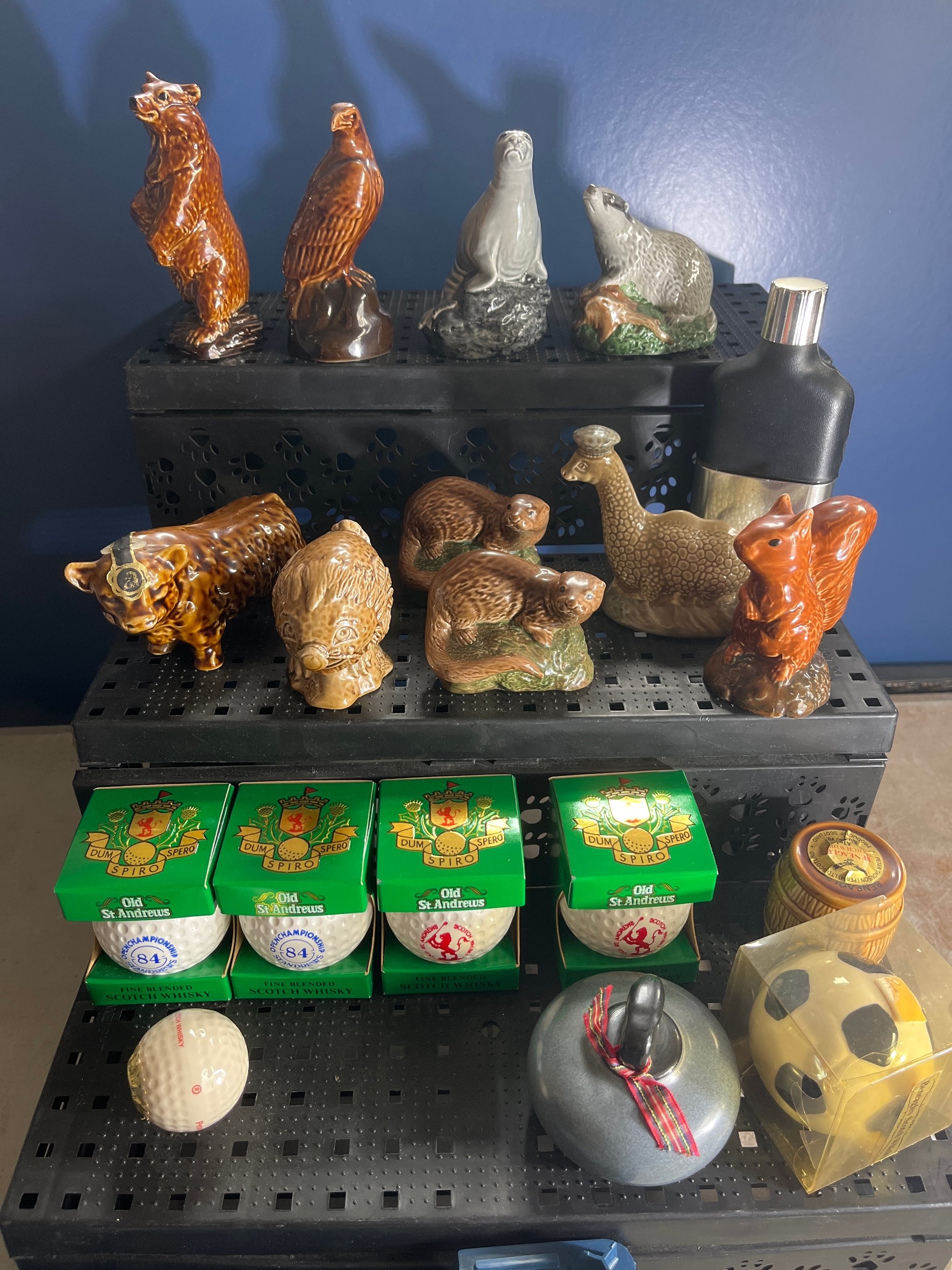
Primary live lot today
Beneagles and Old St. Andrews ceramic Scotch whisky miniature decanters by Beswick, Lot 1172
Auction house: Doncaster Auction Centre
View live lot listing
Estimate: No estimate stated in the listing
Sale window shown in the listing: 26 Aug 2026, 09:30 to 27 Aug 2026, 23:59:59
Catalogue title: Beneagles and Old St. Andrews Ceramic Scotch Whisky Miniature Decanters by Beswick
Photo coverage: two verified catalogue images, with the post hero saved locally from the 1875x2500 full-size `.JPG` and a separate 500x500 preview asset for homepage use
Why this lot is interesting
The attraction here is not rare liquid. It is the collision of three British collecting habits on one shelf: Scotch souvenir culture, animal ceramics from the Potteries, and golf-linked novelty packaging through Old St Andrews. Doncaster’s description is unusually useful because it names the creatures, calls out the golf balls and curling stone, and even records base labels and modeller attributions. That gives bidders something firmer than a vague “box of miniatures” pitch.
The best sentence in the catalogue is probably the most practical one: the badger base still carries a Beneagles Scotch Whisky label for Peter Thomson (Perth) Ltd and the owl is incised “Modelled by J. Tongue 1969 BESWICK”. That matters because this sort of lot lives on survival details. If the labels, stoppers, and moulded names are still present, the group stays collectible across whisky, ceramics, and Scottish ephemera lanes. If too much of that specific identity has gone missing, you are left with charming shapes and less of a real collecting case.
Who buys this and why
- Whisky advertising and distillery ephemera buyers: they want branded Scotch objects that still carry their labels, forms, and period novelty intact.
- Beswick and Royal Doulton animal-ceramics collectors: they are interested in modeller names, mould quality, and whether the figures still stand up as pottery once the whisky story is stripped away.
- Scottish golf and souvenir crossover buyers: they will care about the Old St Andrews golf-ball miniatures because they place the lot in a very specific tourism-and-gift lane rather than in generic drinks memorabilia.
Where the ceramic risk sits
- Read the group as a group first: a mixed lot only earns space if it looks intentional on a shelf, not like the remainder tray after stronger pieces have already left the room.
- Check stopper survival and neck cleanliness: miniature whisky ceramics lose conviction fast when corks are missing, necks are chipped, or the tops look forced rather than original.
- Use the catalogue text to audit what should be present: labels for Peter Thomson (Perth) Ltd, Beswick marks, and modeller names are part of the value here, not small-print extras.
- Watch for cracked ears, tails, and projecting details: animal-form decanters hide damage in exactly the areas that make them charming.
- Treat the golf-ball miniatures differently from the animals: the golf pieces are about branding and complete packaging, while the animals rely more on modelling crispness and surface condition.
- Do not confuse quantity with strength: this lot includes a lot of forms, but two or three weak survivors can drag the whole shelf from collectible to merely decorative very quickly.
Comparator lots
These links stay in the whisky-ceramics lane rather than drifting into ordinary glass decanters or modern spirits. The useful question is what kind of Scottish drinks object you want: a mixed shelf, one comic miniature, or a cleaner single animal bottle with intact branding.
- A small Beneagles Scotch whisky Beswick haggis, 7cmH, Lot 64 — Auction house: Stuart Auctions, Enniskillen. This is the pocket-sized comparator. It strips the category down to one comic Beneagles survivor and helps show how much of today’s appeal comes from variety rather than from one standout individual piece. view lot
- Beswick osprey ceramic sealed blended Scotch whisky liquor bottle, modelled by D. Lyttleton, 1977, Lot 53 — Auction house: Hamilton Square Auctioneers. This is the condition-led comparator. The listing notes a sealed bottle in good condition, which helps frame how much better a single complete bird can look when the buyer wants one display piece rather than a crowd. view lot
- Royal Doulton 17.2cm whisky decanter in the form of a barn owl, Beswick Model No. 2809, commissioned by Whyte & Mackay Distillers, Lot 25 — Auction house: A.S.H. Auctions (ASH). This is the stronger maker-name comparator. It moves the conversation toward single-form display quality and commissioned distillery branding, which may appeal more to buyers who would rather own one decisive owl than a busier mixed shelf. view lot
UK culture context
The reason a lot like this still works in Britain is that it is not only about alcohol. The Scotch Whisky Association notes that Scotch distilleries remain one of Scotland’s most visited attractions, which helps explain why branded whisky objects keep slipping beyond drinks collecting and into tourism memory, gifting, and regional identity. Beneagles miniatures were built for exactly that overlap: part bottle, part mascot, part souvenir.
The Old St Andrews golf-ball pieces matter for the same reason. The R&A World Golf Museum in St Andrews frames the town as the long-running ceremonial centre of golf, so any miniature that borrows the St Andrews name is borrowing one of the most commercially durable place-brands in British sport. Then there is the pottery side. Heritage Crafts’ overview of industrial pottery is a useful reminder that the British market for moulded ceramic novelties was sustained by serious manufacturing depth in the Potteries, not by whim alone. This lot makes sense when you read it through all three lenses at once.
- Scotch Whisky Association: Scotch Whisky distillery visits reach 2 million — helpful on how whisky tourism became a mainstream Scottish visitor habit, which is the cultural backdrop for branded souvenir miniatures.
- The R&A World Golf Museum — useful on St Andrews as a heritage-heavy golf centre, which makes the Old St Andrews golf-ball miniatures more legible as place-branded objects.
- Heritage Crafts: Industrial pottery — good context for the manufacturing world that made British ceramic novelty wares and animal-form bottles plausible at scale.
Bottom line
This is a lot for buyers who enjoy shelves with personality but still want enough hard detail to justify them. Doncaster’s description is specific, the local hero comes from a genuine 1875x2500 source image, and the mixture of Beneagles animals, Old St Andrews golf pieces, and named Beswick modelling gives the group more shape than most mixed whisky lots manage. The risk is equally obvious: with only two catalogue images, you are relying heavily on label survival, stopper completeness, and the auction house description being borne out in hand. If you want one immaculate trophy decanter, buy the owl or the osprey instead. If you like Scottish whisky ephemera precisely when it looks busy, varied, and a little eccentric, this group has a credible case.
Editorial analysis for educational purposes only. Final bidding decisions, fees, tax, shipping, collection, condition confirmation, and contract terms are handled by the auction house.