Daily Deep Dive · 3 Sep 2026 · Jewellery
Lot Spotlight: the Robert Allison brooch that has to win on wirework before the smoky quartz starts charming you
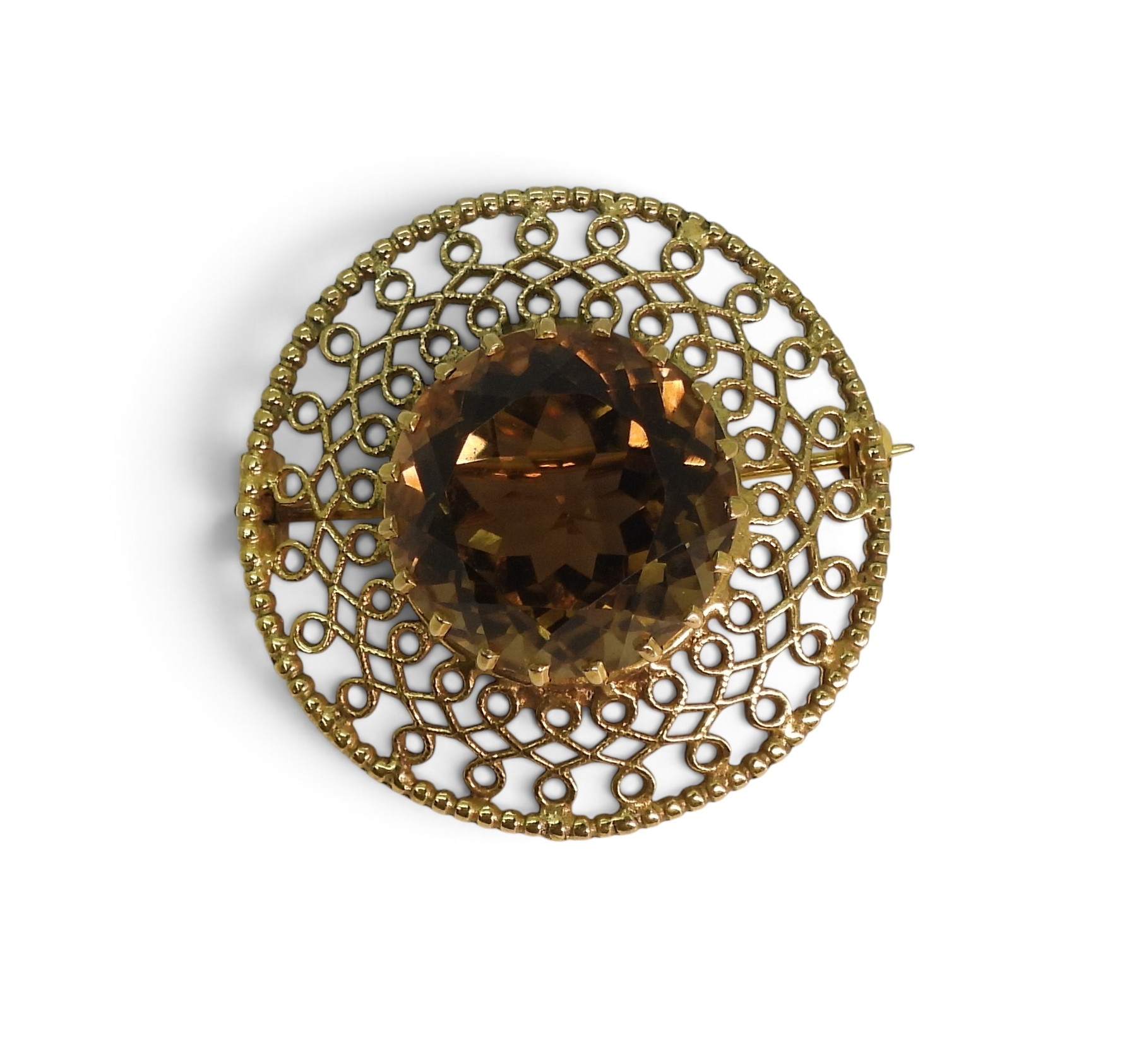
A smoky quartz brooch only earns its keep once the stone stops being a pleasant brown circle and starts acting like jewellery. The Great Western Auctions Ltd has a live 9ct gold Robert Allison filigree brooch set with a large smoky quartz, Lot 763, estimated at £150-£250 and backed by four magnifiable catalogue images, with the post hero saved locally from a verified 1804x1685 full-size image family. The maker name and 10.4g weight lift it above generic second-hand filigree, but the real decision sits elsewhere: whether the goldwork still has enough definition, the quartz still has enough life, and the reverse still looks tidy enough for this to read as a composed brooch rather than a warm-coloured stone carrying too much of the argument by itself.
Primary live lot today
A 9ct gold Robert Allison filigree brooch set with a large smoky quartz, Lot 763
Auction house: The Great Western Auctions Ltd
View live lot listing
Estimate: £150-£250
Sale window shown in the listing: 3 Sep 2026, day two of the two-day sale, with the page showing an end time of 11:59pm BST
Catalogue detail: Robert Allison named in the listing, 3.5cm diameter, total weight 10.4g
Photo coverage: four catalogue images, with the post hero saved locally from a verified 1804x1685 full-size `.JPG` and a separate local preview asset from the source `_PREVIEW` image
Why this lot is interesting
Some brooches trade almost entirely on stone size. This one feels more disciplined than that. The Robert Allison attribution gives the lot a proper maker hook, while the circular filigree body suggests a piece that was designed to look airy rather than merely ornate. That combination matters because smoky quartz can go flat very quickly if the surrounding metalwork lacks tension. Here, the gold is supposed to keep the whole thing light on its feet.
The estimate is also pitched in a useful middle ground. It is high enough that buyers should expect more than scrap-plus-sentiment, but low enough that the lot can still make sense if the photos confirm honest wear rather than hidden trouble. Four views are not museum-level documentation, yet they are enough to test the fundamentals: stone surface, claw security, filigree sharpness, and whether the back has been repaired in a way that drains the front of its confidence.
Who buys this and why
- Buyers of vintage gold brooches with a maker angle: they want more than a generic round pin and will pay for a named piece if the construction still feels crisp.
- Dealers and trade buyers in wearable period jewellery: they are checking whether the quartz and catch work are strong enough to justify margin after routine cleaning and a close condition check.
- Private buyers who actually wear brooches on coats, knits, and scarves: they need the brooch to read clearly at a distance, sit securely, and avoid the heavy-handed look that can make smoky quartz feel costume-adjacent.
Where the risk sits
- Read the quartz for life, not just size: smoky quartz should still show depth and a clean surface. Clouding, abrasions, or a dull table will flatten the whole brooch very quickly.
- Check the claws and inner edge: on a stone-led brooch, tiny distortions around the setting often tell you more than the catalogue title does. Look for uneven pressure, gaps, or evidence of past resetting.
- Study the filigree for compression: the charm here lives in openwork delicacy. Bent sections, clogged solder, or flattened wire can turn an elegant maker-led piece into something merely busy.
- Turn the brooch over mentally: the reverse matters. Hinge, pin stem, and catch should look proportionate to a 10.4g brooch rather than like later repairs bolted onto an older front.
- Use the scale honestly: 3.5cm is a wearable size, but only if the brooch keeps some visual lift. If the quartz reads heavier than the goldwork, it may wear more stubbornly than gracefully.
Comparator lots
The best comparators are not all exact smoky-quartz matches. They are neighbouring brooch decisions from the same live jewellery run: one lower-ticket diamond bow, one mixed-lot colour option, and one pricier ribbon bow where the money is being asked to sit more in finish than in maker identity.
- A 9ct gold diamond set bow brooch, Lot 706 — Auction house: The Great Western Auctions Ltd. Estimate: £80-£120. This is the lighter, cheaper comparator: smaller scale, less maker pull, and a buying case built around tidy outline and a modest diamond accent rather than a substantial central stone. view lot
- A 9ct gold amethyst brooch and a yellow metal peridot-and-pearl brooch, Lot 780 — Auction house: The Great Western Auctions Ltd. Estimate: £70-£100. This is the value comparator. Buyers get two coloured-stone brooches for less money, but with a mixed-lot compromise and no single maker-led focal point to concentrate confidence. view lot
- A yellow metal ribbon bow brooch with diamond accent, stamped 750, Lot 782 — Auction house: The Great Western Auctions Ltd. Estimate: £280-£380. This is the upper comparator. It asks buyers to pay more for cleaner gold presentation and a neater diamond-led finish, which helps show whether today’s Robert Allison lot looks underpriced for its maker and quartz presence or fairly pitched for its wear risk. view lot
UK culture context
National Museums Scotland is useful here because it explains why smoky brown quartz sits so deeply in the Scottish jewellery imagination. Its cairngorm quartz essay notes that these stones carried ideas of landscape, ancestry, and place rather than the flashier sparkle buyers expect from diamonds. That matters for this brooch even if the listing does not claim a Cairngorm-origin stone. The attraction of a smoky quartz piece is supposed to be warmth, geology, and character held inside a disciplined setting, not brute brilliance.
The present UK trade lane still treats Scottish-style brooches as a live market rather than a costume backwater. Sellingantiques.co.uk currently aggregates antique Scottish brooches across multiple UK dealers, with quoted asking prices spanning from roughly £100 to nearly £1,000. That does not prove auction value, but it does show why a named filigree brooch at a £150-£250 estimate deserves a closer read. The estimate is not being asked in a vacuum.
- National Museums Scotland: Geology to Jewellery: The history and science of Cairngorm quartz — museum context for why smoky Scottish quartz jewellery carries cultural weight beyond simple gemstone brightness.
- Sellingantiques.co.uk: Antique Scottish brooches — a practical UK dealer-market snapshot showing the current retail lane for related brooch forms.
Bottom line
This is the sort of brooch that can look far more expensive than it is if the wirework stays crisp and the quartz still has depth. If the reverse is clean, the setting looks undisturbed, and the stone surface has not gone dead, the estimate is sensible and potentially attractive. If the brooch turns out to be all centre-stone mood and compromised engineering, the Robert Allison name will not rescue it for long.
Editorial analysis for educational purposes only. Final bidding decisions, fees, tax, shipping, collection, condition confirmation, and contract terms are handled by the auction house.