
Daily Deep Dive · 4 Sep 2026 · Wine & Spirits
Lot Spotlight: a 1959 Armagnac where the date is the easy part and the storage story does the real selling
Vintage Armagnac can make buyers lazy because the year on the label arrives before any of the useful questions. Gorringe’s has a live 1959 Maison Gélas Vintage Bas Armagnac, Lot 318, estimated at £200-£300 and offered in its wooden case with two verified catalogue images, while the post hero has been saved locally from a 1365x2048 full-size `.JPG` and paired with a separate 500x500 preview for homepage use. That is enough to make this a proper judgement call rather than a birth-year daydream, because the date is not the hard part. The hard part is deciding whether the fill, closure, label, and box still support the same confidence as the year printed on the front.
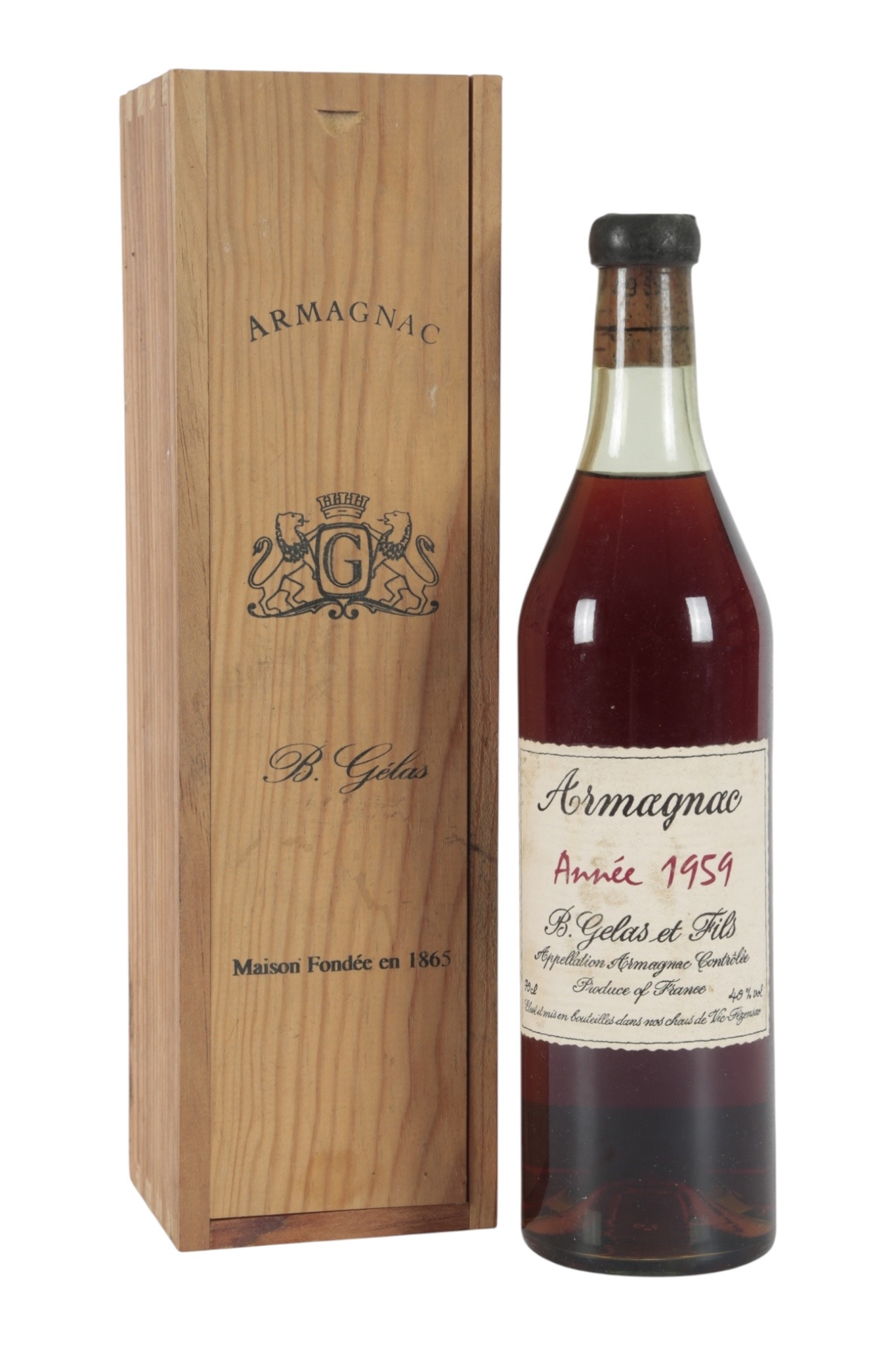
Primary live lot today
1959 Maison Gélas Vintage Bas Armagnac, France, in wooden case, bottled 1999, Lot 318
Auction house: Gorringe’s
View live lot listing
Estimate: £200-£300
Sale window shown in the listing: 7 Sep 2026 from 10:00 BST, with the page showing an end time of 23:59:59 BST
Catalogue detail: Maison Gélas states the bottle matured for 40 years in oak before bottling in 1999, with tasting notes of dried figs, prunes, and leather
Photo coverage: two catalogue images, with the post hero saved locally from a verified 1365x2048 full-size `.JPG` and a separate local preview asset from the source `_PREVIEW` image
Why this lot is interesting
There are two ways bottles like this get bought in Britain. One is with the heart first: a 1959 birth year, a substantial wooden case, and the comforting idea that old French brandy still sits below trophy-whisky pricing. The other is with the shelf first: does the object look calm, well-kept, and coherent enough that the date is confirming quality rather than distracting from condition. This lot is interesting because it can plausibly satisfy both instincts if the bottle has been stored properly.
The estimate is also pitched in a lane that makes comparison possible. At £200-£300, Gorringe’s is not presenting this as a throwaway dinner-party bottle, but it is still well below the kind of money one vintage single malt can demand on reputation alone. That gives the lot a real thesis: not brand swagger, but mature spirit, vintage specificity, and presentation value bundled into one object. Buyers just need to remember that vintage Armagnac is only a bargain while the practical signs stay quiet.
Who buys this and why
- Birth-year bottle buyers: they want the emotional force of 1959, but only if the bottle and case still look giftable rather than merely old.
- Collectors of mature brandy and underpriced brown spirits: they are looking for a bottle that feels serious without needing whisky-market theatrics to justify the spend.
- Dealers and private hosts who buy for the shelf as much as the pour: they need the label, fill, and case to work together because tired presentation destroys resale confidence and room presence at the same time.
Where the risk sits
- Start with the fill level: an old Armagnac does not need to look factory-fresh, but the shoulder and neck should still feel reassuring rather than evaporated into nostalgia.
- Read the closure area carefully: seepage, staining, or a capsule that looks disturbed can erase the romance of a vintage year in one glance.
- Check the label for confidence: edge wear is fine, but heavy scuffing, lifting, or staining changes the lot from handsome stored bottle to compromised attic survivor.
- Do not treat the wooden case as scenery: hinges, corners, and interior fit matter because the box is carrying part of the lot’s premium, not just protecting it.
- Use the glass colour honestly: deep amber can be seductive, but buyers still need to ask whether they are seeing mature spirit, warm photography, or a bottle whose best work is being done by presentation.
Comparator lots
The comparator logic here is straightforward: one cheaper large-format bottle from the same sale, one mid-range boxed Armagnac from the same run, and one cross-house 1960 vintage bottle that tests how much today’s estimate is really charging for year, presentation, and confidence.
- 1973 Domaine de Brichot Armagnac 150 cl bottle, Lot 319 — Auction house: Gorringe’s. Estimate: £50-£100. This is the value-and-volume comparator: more liquid and less ceremony, useful for buyers deciding whether they care more about statement vintage or practical bottle size. view lot
- De Montal Vintage Millesime Armagnac, France, in presentation box, Lot 320 — Auction house: Gorringe’s. Estimate: £100-£150. This is the presentation comparator. It still offers a boxed vintage Armagnac, but at roughly half the estimate, which helps show how much the Maison Gélas lot is leaning on the 1959 date and 40-year maturation story. view lot
- Armagnac Baron de Sigognac 1960, 40% vol, 70cl, in wooden presentation box, Lot 147 — Auction house: Auctioneum Ltd. Estimate: £100-£200. This is the nearest cross-house comparator because it keeps the old-vintage-plus-wooden-box formula intact while asking noticeably less, and it comes with five catalogue images rather than two. view lot
UK culture context
Vintage Armagnac has a useful place in British buying culture because it behaves differently from whisky. Decanter framed that difference cleanly in April 2026, arguing that vintage Armagnac swims against a spirits market often dominated by age ladders, prestige ladders, and price ladders. That is exactly why a lot like this can appeal: buyers are not just chasing a famous distillery name, they are buying a dated object whose appeal sits in year-specific character and presentation.
The Guardian made the practical British case even more bluntly in late 2024, calling Armagnac the “biggest bargain in spirits” and using the idea of a 40th-birthday bottle to explain why vintage Armagnac still feels legible to UK buyers. That helps with Lot 318. A 1959 bottle in a wooden case is not selling only as drink. It is selling as a year marker, a gift object, and a calmer alternative to the louder status games of mature whisky. I found no credible UK social-pulse source today that improved the buying case more than those two published references.
- Decanter: Vintage Armagnac: What difference does a year make? — useful on why vintage Armagnac resists the usual prestige-price ladder and stays interesting as a year-specific category.
- The Guardian: Armagnac, the secret bargain of the spirits world — helpful on the UK gift-and-value reading of old Armagnac versus the much louder pricing culture around mature whisky.
Bottom line
This bottle makes sense if you are buying the whole proposition and not just the year. If the fill is healthy, the closure looks undisturbed, the label stays tidy, and the wooden case still feels crisp, Gorringe’s estimate is reasonable for a 1959 vintage Armagnac that presents well. If the bottle turns out to be mostly date, mostly box, or mostly atmosphere, the premium disappears quickly and the bargain story goes with it.
Editorial analysis for educational purposes only. Final bidding decisions, fees, tax, shipping, collection, condition confirmation, and contract terms are handled by the auction house.